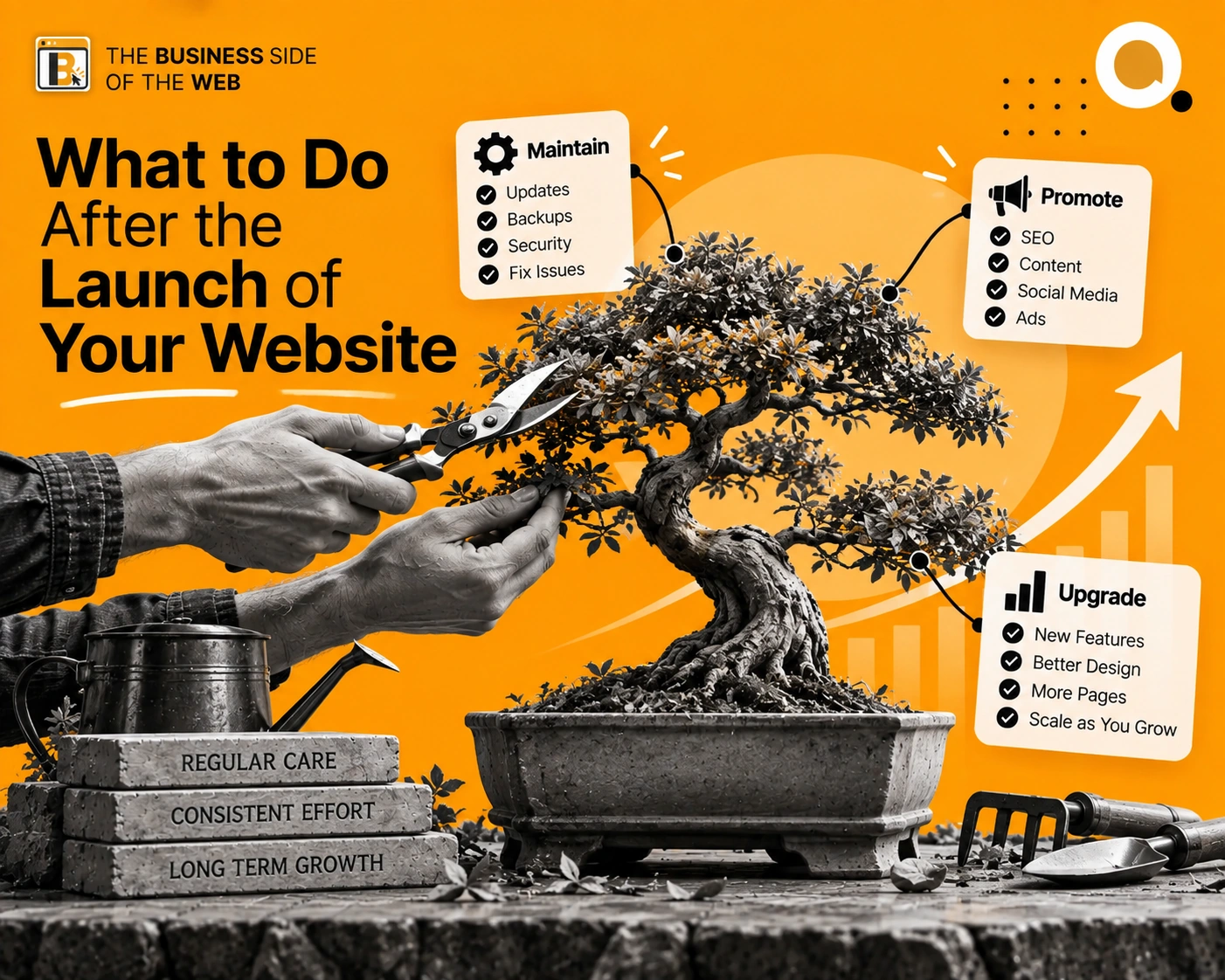
For the business owner who thinks "live" means "done."
You tested the forms. You checked the checkout. You watched the first real visitors move through the site in Week 1 and Week 2, fixed what confused them in Week 3, and turned the traffic on in Week 4. If you followed How to Plan a Website That Actually Does Something, you already know launch day is Day 1, not the finish line.
So here's the question nobody prepares you for: what happens on Day 31?
Most businesses don't have an answer. They ran a great first month, felt the momentum, and then quietly went back to running the rest of the business - leaving the website to coast on whatever traffic and rankings it already had. Six months later, it's coasting on nothing.
A website doesn't fail after launch because the business stopped caring. It fails because nobody told them that "after launch" isn't a phase - it's a loop.
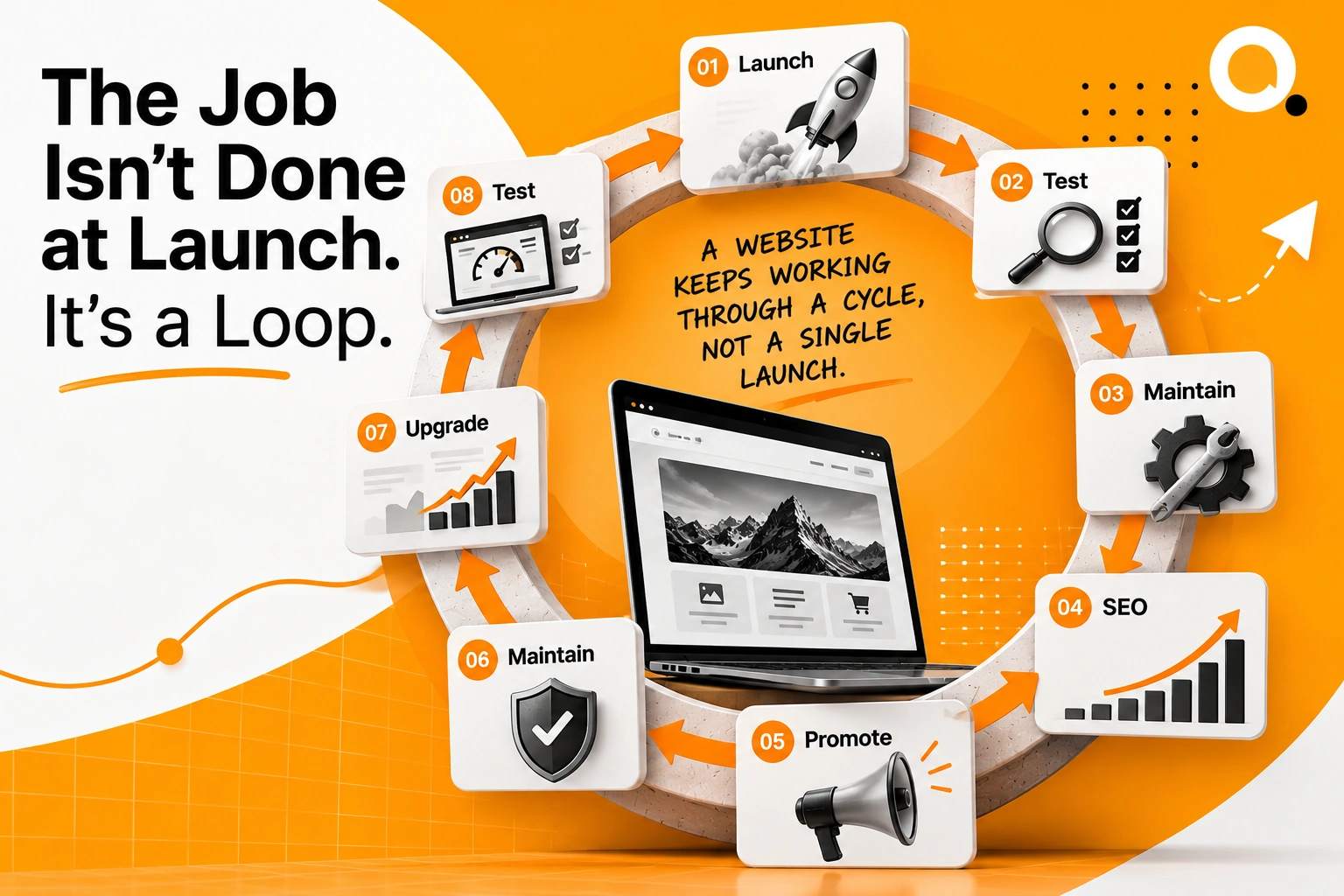
The Job Isn't Done at Launch. It's a Loop.
Every blog in this series has come back to the same idea: your website exists to do a job. Presence, trust, leads, sales, bookings, or a portal - Blog 05 made you write that job down in one sentence before you even started building.
Launch doesn't finish that job. It just hands it over to the next phase, where the job actually gets done - repeatedly, in a cycle that never technically ends:
Mini Framework: The Post-Launch Loop
Launch → Test → Maintain → SEO → Promote → Maintain → Upgrade → Test → Launch
Every stage feeds the next one. Skip a stage, and the loop breaks, you either promote a site that isn't ready, or you sit on a perfectly built site that nobody sees. Let's walk through it in order.
Step 1: Test the Website Like a Stranger Would Use It
Before anything else goes live to the public, test it the way a customer would experience it - not the way you, the person who built it, already knows how to use it.
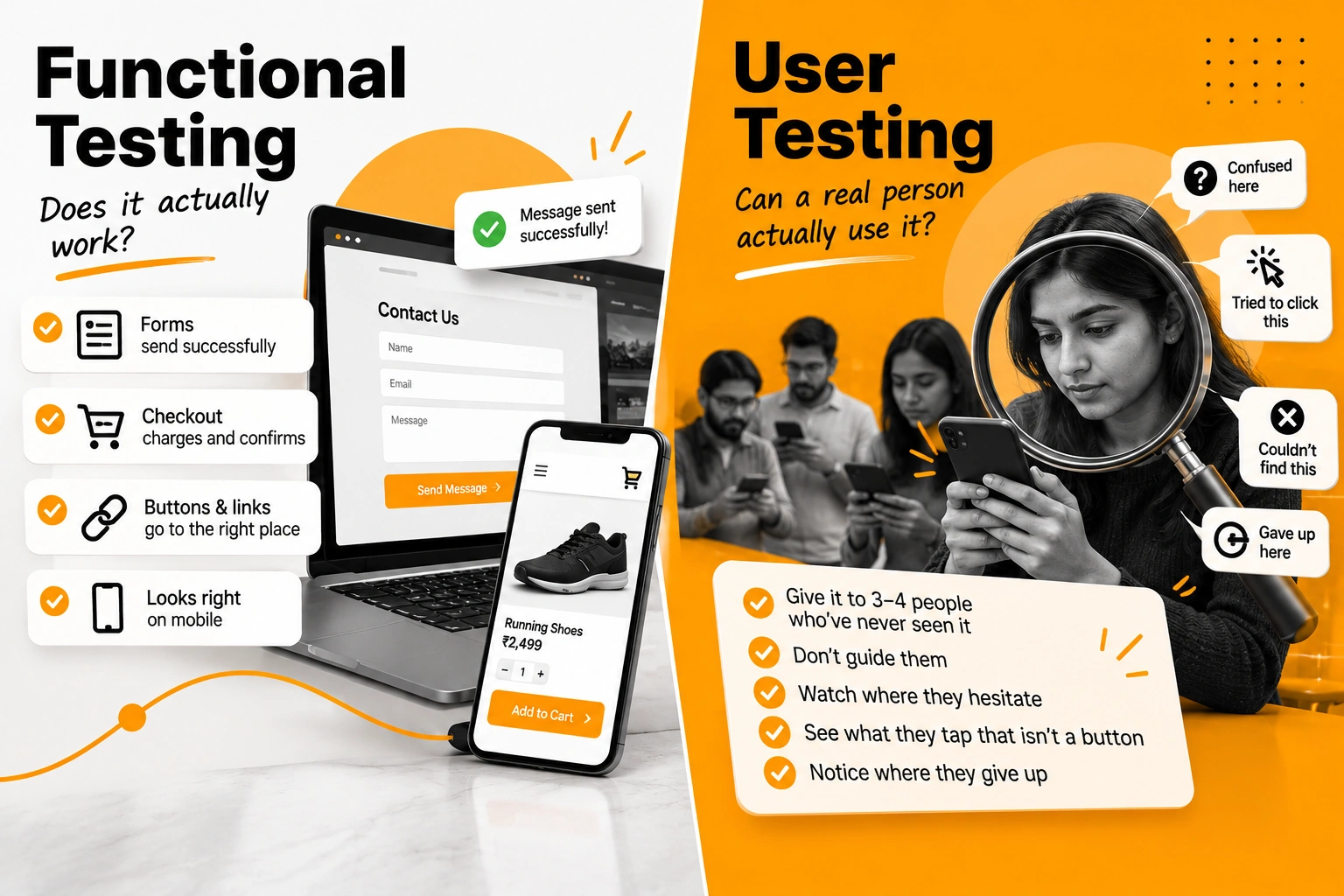
You don't need to be technical to do this well. Two kinds of testing matter here:
Functional testing
- Do the forms actually send? Does checkout actually charge and confirm? Do the buttons go where they say they'll go? Does the site look right on a phone, not just on the laptop it was designed on?User testing
- Hand the site to three or four people who've never seen it and just watch them. Don't guide them. Watch where they hesitate, what they tap that isn't a button, and where they give up. This tells you more in twenty minutes than a week of guessing ever will.
Only once you're confident the site can carry the weight of your brand - that it won't crash, embarrass you, or quietly swallow a lead - should you move to the next stage.
Step 2: Run It Internally Before You Push It Publicly
Before the website meets the public, it should meet your own team.
Get comfortable in the dashboard yourself. Know how to update a price, add a case study, or check who submitted a form without needing to message a developer. Walk through your own business's workflow inside the website the way a lead would move from enquiry to conversation to close and make sure it matches how your team actually operates.
This step gets skipped constantly, and it's usually why businesses come back to their developer four months later asking, "Wait, how do I change this?" If you're not fluent in your own website before you publicize it, you're not ready to run it - you're just hosting it.
Step 3: Start Feeding It Content - And Let SEO Work in the Background
Once you and your team are comfortable running the site, start putting content into it. Blog posts, articles that show your expertise, case studies, brand updates, anything that signals to Google, and to a visitor doing their research, that this is a real, active business.
This is also where SEO enters the picture. And it deserves an honest expectation set upfront:
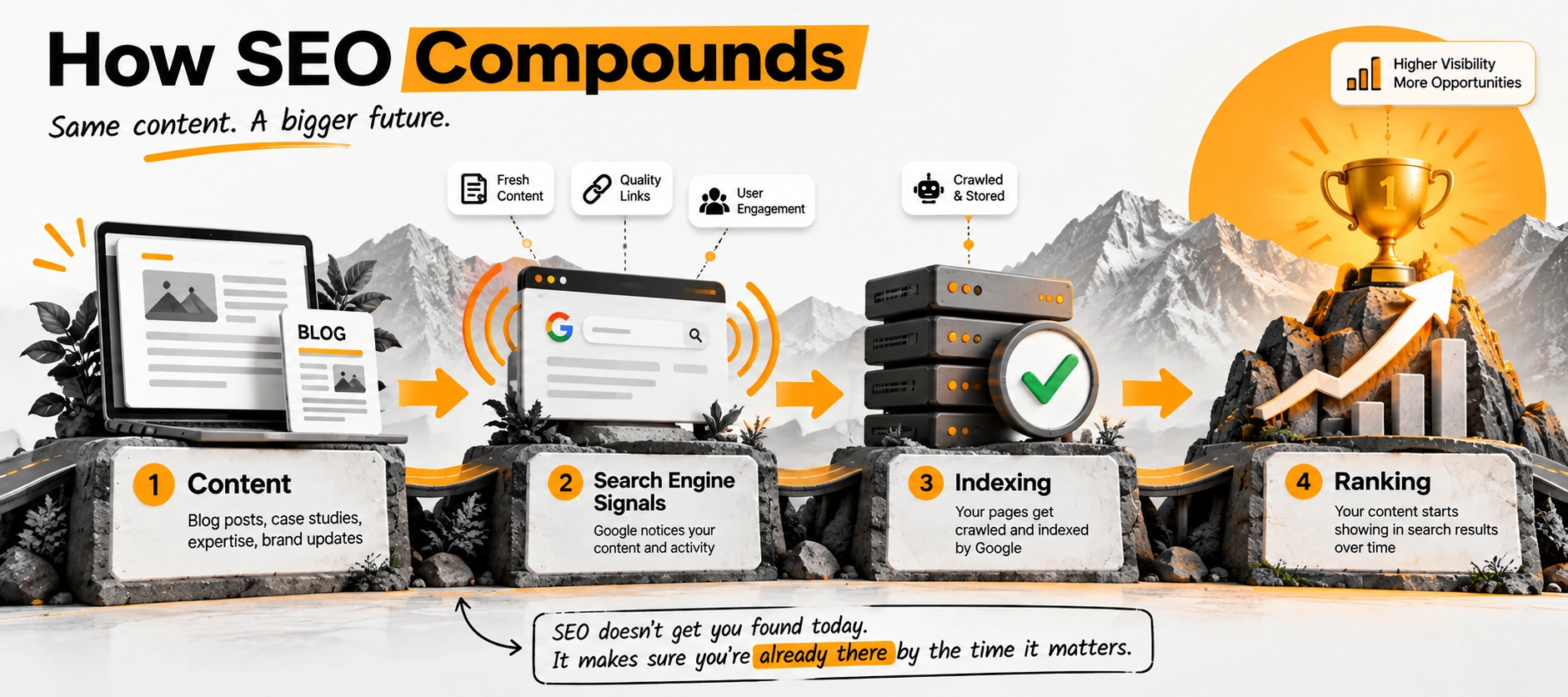
It's not a switch, it's a slow compounding signal. What it does instead is far more valuable over time, it builds the foundation so that when your brand does scale online, your visibility isn't starting from zero. SEO activities need to be done ahead of time, not reactively, so your brand's online reputation doesn't panic later when you need it most.
Mini Framework : How SEO CompoundsContent → Search Engine Signals → Indexing → Ranking
One-line punch: SEO doesn't get you found today. It makes sure you're already there by the time it matters.
We'll go deeper into specific SEO tactics in a dedicated blog - for now, the gist is this: treat content and SEO as infrastructure you're laying down early, not a campaign you launch later.
Step 4: Once Google Knows Your Name, Start Promoting It
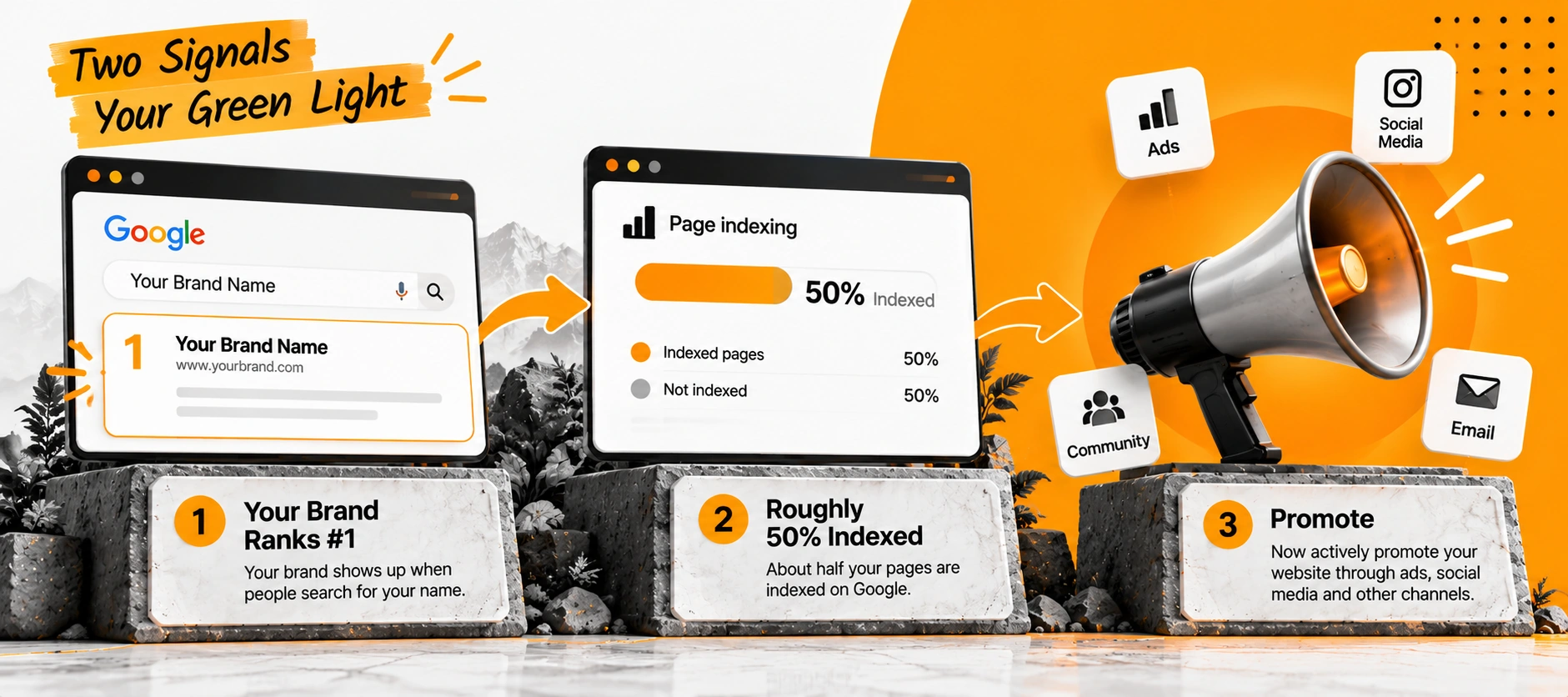
There's a clear signal that tells you when it's time to move from "building SEO in the background" to "actively promoting the site": your brand starts showing up when people search your own company name, and roughly half your pages are indexed on Google.
That's your green light.
Here's the part worth being blunt about: putting your links on other sites during your SEO activities is not the same as promotion, and by itself, it's not enough. In 2026, everyone does that. It's necessary as a backup, but it isn't a growth strategy on its own. You still need to actively promote your website - through ads, social platforms, and wherever your audience already spends time - to bring in the traffic that lets the site do its actual job.
And once that traffic arrives, don't just watch the number go up. Measure whether it's doing what it was built to do.
Success Ratio = (Visitors Who Complete the Job ÷ Total Visitors) × 100
If your website's job was defined back in Blog 05 as generating enquiries, this is where you check: out of everyone who showed up, what percentage actually enquired? Blog 04 walked through the fuller version of this math - traffic × conversion × customer value. This is the simpler, ongoing pulse check you run every time you send traffic somewhere.
Step 5: Maintain What You're Now Promoting

The moment you start sending real traffic to the site, maintenance stops being optional housekeeping and becomes protection for the money you're spending to get people there.
This is the same Maintain bucket from Blog 04 - hosting, security, backups, bug fixes, small content updates - except now it's running in parallel with active promotion, not just sitting quietly in the background. A broken form during a launch week is annoying. A broken form while an ad campaign is live is money you paid for, thrown away.
The Loop Repeats And After 2-3 Cycles, Something Changes
Test, maintain, add content and SEO, promote, maintain again - then you do it again. And again.
Somewhere around the second or third time through this pipeline, something shifts. Your team stops treating traffic spikes as emergencies. Handling enquiries, updating content, and reading analytics becomes a rhythm instead of a fire drill. Your brand gets used to handling and maintaining traffic online.
This is the payoff that doesn't show up in a spreadsheet the first month - but it's real, and it compounds. People start recognizing your brand without being told who you are. Your operation becomes scalable at whatever level you choose to multiply it to. You've opened a door that opens several more doors, and the only real decision left is which one to walk through next.
Where Mediocre Brands Get Stuck

Here's the part most businesses don't expect: this is also exactly where average brands plateau, or get stuck circling the same loop without ever growing out of it.
The businesses that break past this point do one specific thing the others don't — they actually look at what their traffic is telling them. Not once, at launch. On a rhythm: at least once a month, once a week if the business can support it, and always once a pipeline cycle wraps up and before the next one begins.
Mini Framework — Breaking the Plateau
Analyze the Traffic → Identify the Gap → Prioritize the Opportunity → Upgrade the SiteWhat are visitors trying to do that the current site doesn't support well? What's the drop-off point that's been quietly costing you conversions for two cycles now? That analysis is what turns "we have a website that works" into "we have a website that keeps getting better."
Step 6: Upgrade the Website, Not Just the Ads
Based on what that traffic analysis tells you, upgrade the site itself — new features, better flows, a revamp of the sections that are underperforming. A full redesign every year or two is normal and healthy, not a sign that the last build failed.
This matters more than it sounds like, because of a shift that's already happened by this stage: you're no longer relying solely on a rented platform for your presence. Blog 01 called this out from day one — Instagram is a rented room, your website is the one you own. Now that it's carrying real weight for your business, it needs the same ongoing investment and updates you'd give any piece of infrastructure that your revenue actually depends on.
Step 7: When You Reach v2.0, Go Back to Step 1
Once the upgrade or revamp is built, don't skip straight to publishing it because "it's just an update." Send v2.0 through the same testing phase the original site went through. Check it the way a stranger would use it. Confirm it holds up before it meets real traffic.
Then launch it - and the circle starts again.
Pull It All Together: The Post-Launch Operating Cycle
TEST :
Confirm the site works functionally and confirm real users can move through it without confusion.RUN IT INTERNALLY
: Get your team fluent in the dashboard before the public sees the site.CONTENT + SEO
: Publish blogs, case studies, and updates. Let search signals build quietly in the background.PROMOTE
: Once you're ranking for your own name and roughly half your pages are indexed, start actively driving traffic — and measure your Success Ratio against the job the site was built to do.MAINTAIN
: Protect the traffic you're now paying and working to earn.ANALYZE + UPGRADE
: Review traffic needs on a monthly or weekly rhythm. Revamp every 1–2 years based on what the data actually shows you.BACK TO TEST
: Every new version re-enters the loop at Step 1.
Start Here
A loop only works if you actually run it. Here's a simple cadence to build into your business rhythm, regardless of what stage you're at:
Frequency | What to Do |
Weekly | Check forms, checkout, and any recent content for errors. Skim analytics for anything unusual. |
Monthly | Review traffic sources and your Success Ratio. Publish at least one piece of new content. |
Every Pipeline Cycle | Sit down and ask: what is the traffic telling us it needs next? |
Every 1–2 Years | Plan a real upgrade or revamp — then run it through Step 1 again before it goes live. |
If you're early in this loop — just past launch, still building your first round of content — your job right now is simple: get comfortable internally, start publishing consistently, and resist the urge to promote before you're indexed and ready. If you're a few cycles in and traffic has plateaued, the fix usually isn't more ad spend. It's an honest look at what that traffic has been trying to tell you, month after month, that nobody acted on.
The Business Side of the Web
You now have the complete picture from "do I even need one" to "how do I keep it growing":
01 — It's High Time Your Business Needs a Website ✓ 02 — What Kind of Website Do You Actually Need? ✓ 03 — How Much Does Website Development Cost in India? ✓ 04 — How Much Should You Spend On Your Website? ✓ 05 — Don't Build a Website You're Not Ready to Run ✓ 06 — What to Do After the Launch of Your Website ← You're here
A website that isn't run is just a very expensive brochure. A website that's tested, maintained, backed by SEO, promoted deliberately, and upgraded on a rhythm becomes the hardest-working asset your business owns.
Ready to keep your website working long after launch day?

Comments