
Two Questions. One Decision.
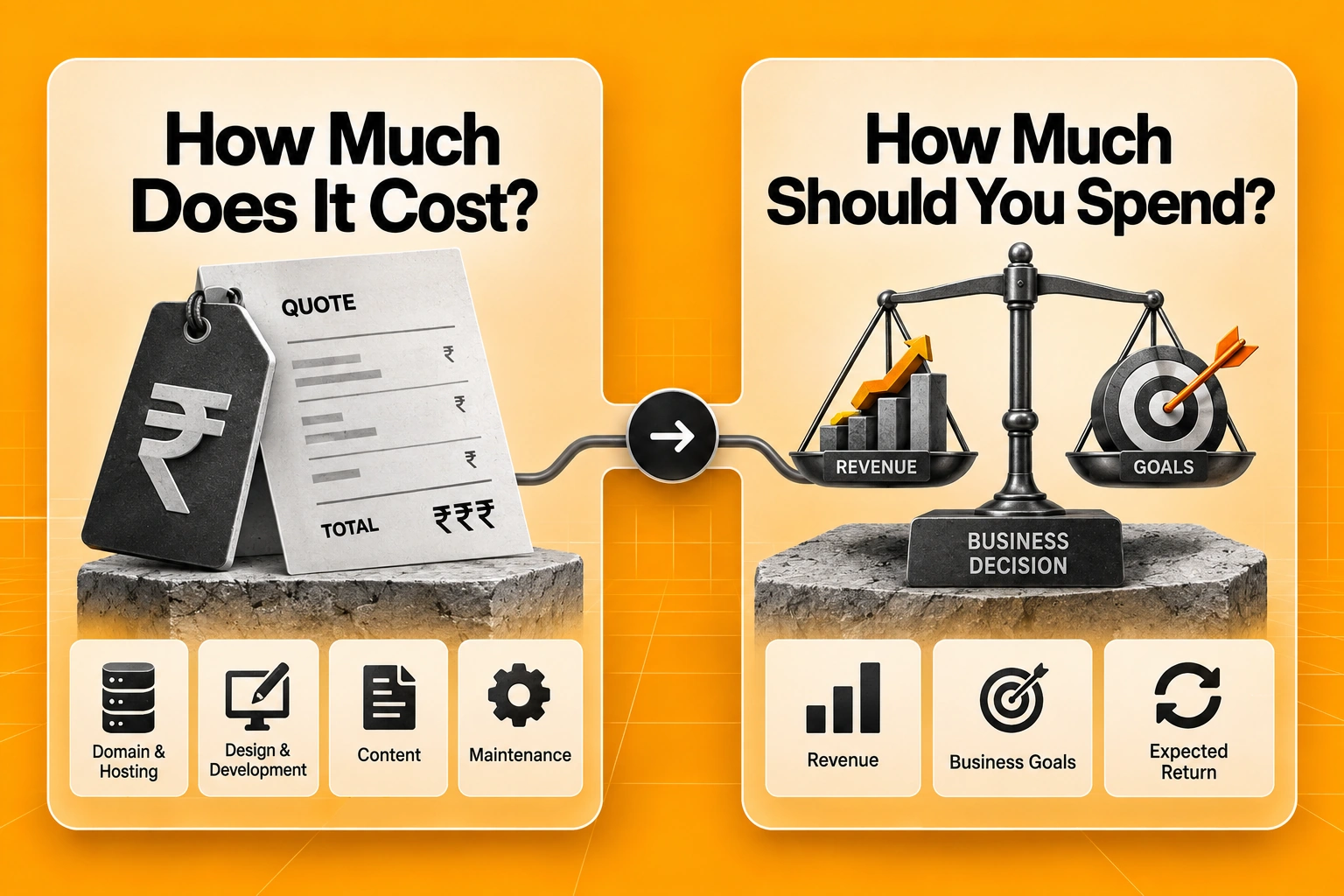
There are two things every business owner needs to understand before spending money on a website.
The first:
"How much does it cost?"
What does the market charge for a website in India? What are the real price ranges - by type, by platform, by what actually goes inside a quote? That's a legitimate question, and it has a factual answer: domain and hosting fees, design and development rates, content costs, maintenance - broken down to the actual number. The next blog covers that in full.
The second:
"How much should you spend?"
That's a completely different question. Not what the market charges — but what your business should invest. Based on how important the website is to how you make money. Based on the type of website you've already identified. Based on what return you can realistically expect from it.
Most businesses only think about the first. They get a quote, compare it to another quote, and make a decision based on price.
The businesses that grow through their websites think about both. They go into the cost conversation already knowing what they should invest - so a quote isn't just a number to negotiate down, it's something they can evaluate against a business decision they've already made.
Mini Framework
Cost = What the market charges
Spend = What your business should invest
Both matter. They just answer different things.
This blog is about the second one.
The through-line connecting all three?
The job.
What the website needs to do decided whether you needed one. It decided what type to build. And it's about to decide how much to invest.
The Formula That Starts the Answer
There is no universal website price. There's only a price that makes sense for your business.
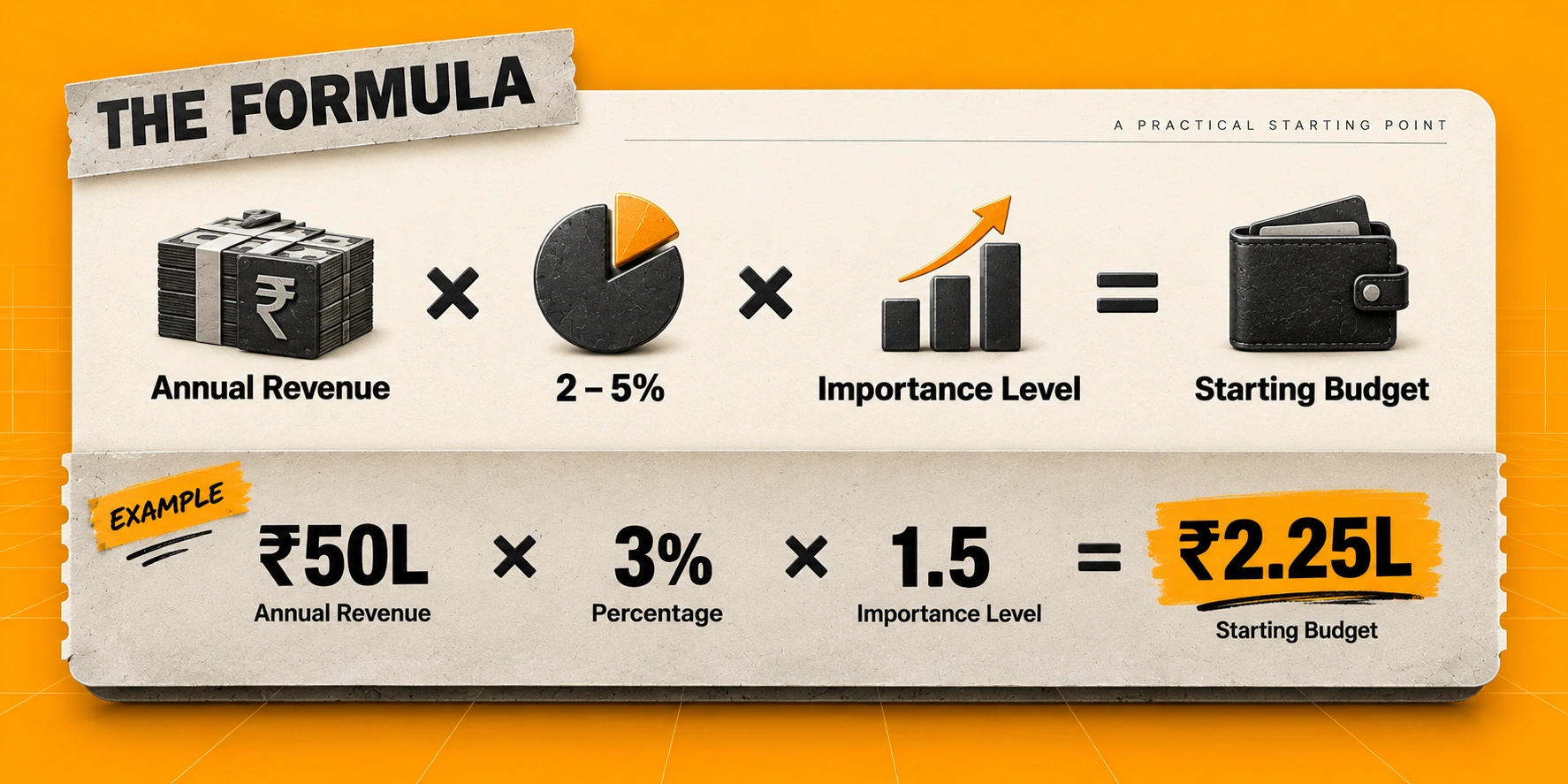
But every good budget needs a starting point - somewhere to anchor the thinking before the quotes arrive. Here's a practical one:
This isn't a rule pulled from a textbook. It's a compass. A way to arrive at a sensible range before you're sitting across from an agency or freelancer who gives you a number you have no way to evaluate.
Picture this:
A mid-size service business earns ₹50 lakh a year. Their website is how most serious prospects research them - not their only channel, but a real one. Clients look them up, read their case studies, and reach out through the contact form. The website matters.
₹50 lakh × 3% = ₹1.5 lakh starting budget
Their website is
High Importance
→ multiply by 1.5Starting estimate: around
₹2.25 lakh
That's not a quote. It's not a bill. It's a number that says: "somewhere around here, if you're serious about this."
What moves it up or down? Two variables: the percentage you apply, and the importance multiplier
you choose. Both of those come from one honest question about the business.How Important Is This Website to Your Business?
This is where the formula stops being generic and starts being yours.
Two businesses with the same revenue can need completely different website investments. One runs almost entirely on word-of-mouth and only needs a website so prospects can confirm it's a real company. The other generates 70% of its leads through the website and would lose significant business without it.
Same revenue. Completely different jobs. Completely different investments.
Here's how to find your level:
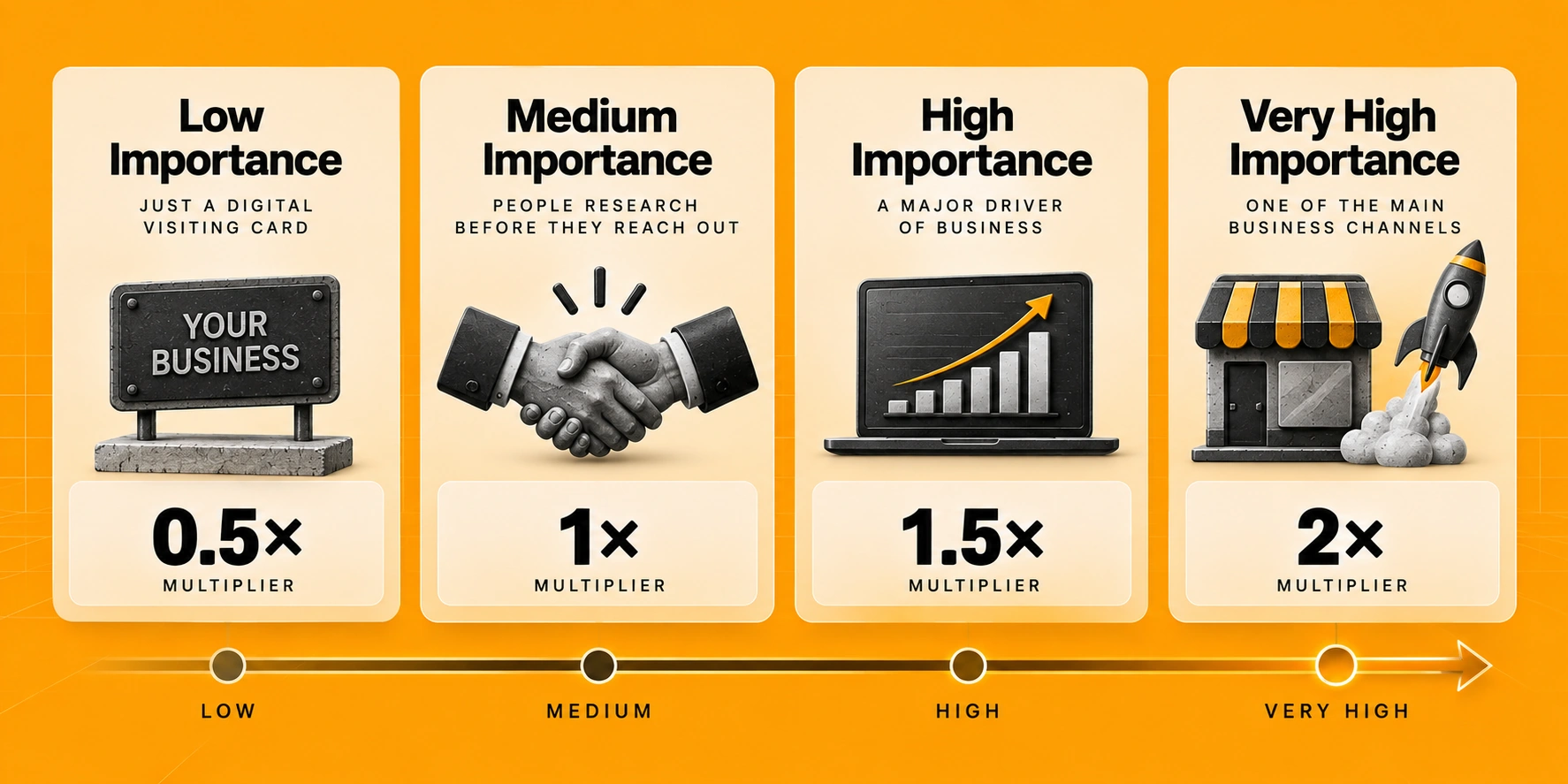
Low Importance — 0.5×
The business operates comfortably without the website actively performing. It mainly exists to confirm you're legitimate when someone searches your name.
Examples: A local contractor whose work comes entirely through referrals. A business that simply needs a Google listing with more detail than a Maps page.
Medium Importance — 1×
The website is a real part of how customers research and reach out. Not the only channel — but an important one. Prospects look you up before they contact you.
Examples: Consultants, professional service firms, agencies, B2B companies where potential clients compare options before making first contact.
High Importance — 1.5×
The website plays a major role in sales, brand credibility, or growth. Underinvesting here doesn't just leave money on the table — it actively loses deals.
Examples: E-commerce, high-value service businesses, companies running performance marketing, businesses expanding into new markets.
Very High Importance — 2×
The website is one of the main business channels. Not supporting the business — it is a significant part of the business.
Examples: Online-first brands, large e-commerce operations, SaaS products, businesses scaling digitally across cities or countries.
The multiplier doesn't just adjust the number. It calibrates what the investment actually needs to accomplish. A 2× website that gets a 0.5× budget doesn't just underperform — it actively undersells the business every single day it's live.
One-line punch: The more the business depends on the website, the more the website deserves proper investment.
What Does That Budget Actually Pay For?
Here's the most expensive mistake businesses make when budgeting a website:
They spend almost everything on building it and leave almost nothing to bring anyone to it.
The website launches. It looks great. Nobody visits. The investment goes quiet.
That mistake has a name: treating the build cost as the whole budget.
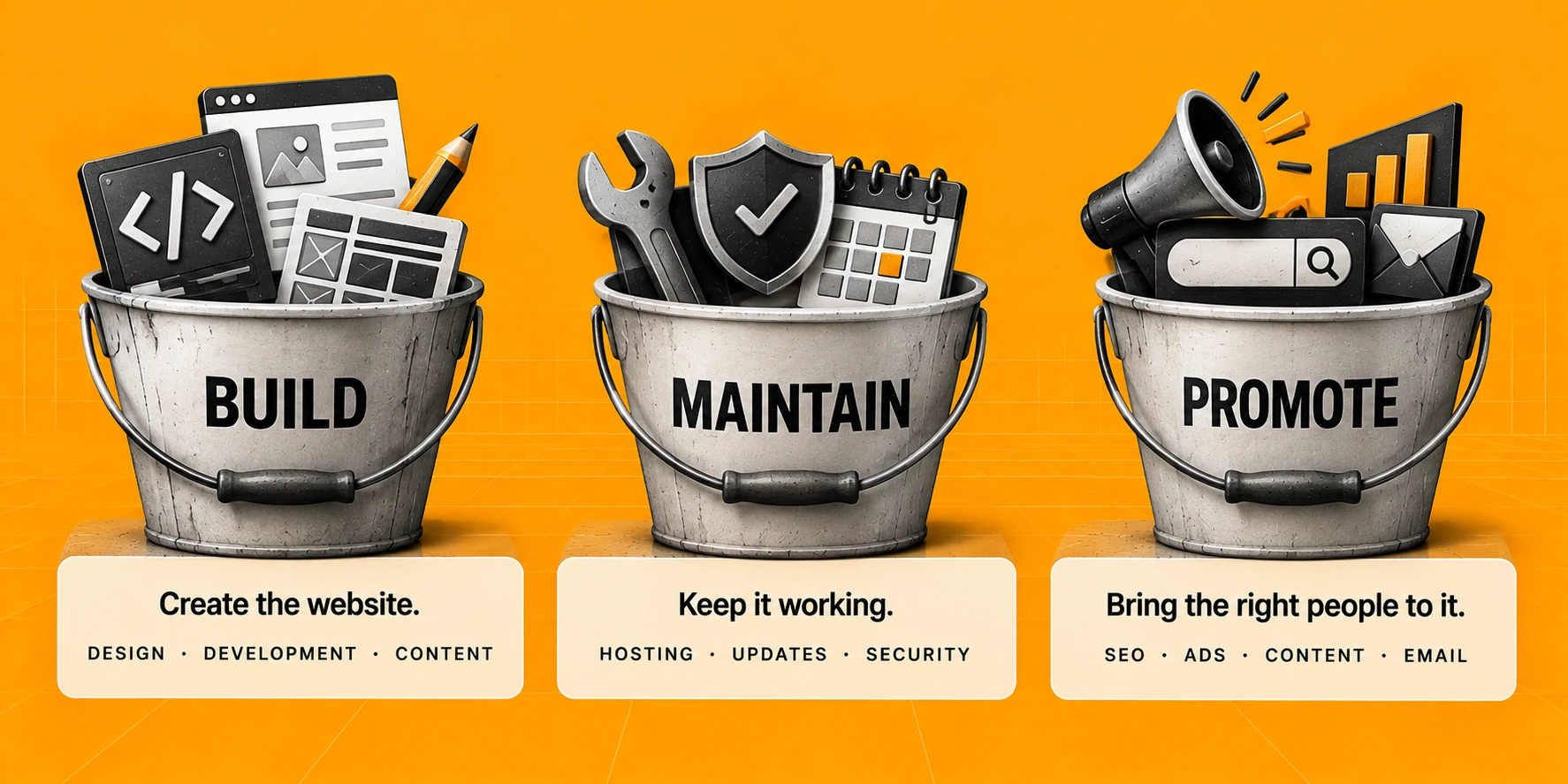
A website budget has three parts, and all three matter equally to the outcome:
BUILD: Creating the Website
The one-time cost of bringing the website to life. Design. Development. Content and copywriting. Integrations. Testing. Launch.
This is the part most people think about. It's only one-third of the picture.
MAINTAIN: Keeping It Working
The ongoing cost of keeping the website useful, secure, and current. Hosting. Domain renewal. Security updates. Backups. Bug fixes. Performance improvements. Small content changes.
PROMOTE: Bringing the Right People to It
The money that turns a built website into an active business asset. SEO. Paid ads. Content marketing. Email. WhatsApp campaigns. Social media.
All three exist in every website budget. The split between them is what changes depending on what the business actually needs.
The Starting Split - And When to Shift It
Here's a useful default to start from:
Area | Starting Share |
Build | 35% |
Maintain | 15% |
Promote | 50% |
This isn't a rule. It's a guardrail one that prevents the most common mistake: a beautiful website that nobody ever sees.
Here's when and how to move these numbers, based on the type of website you identified in Blog 02.
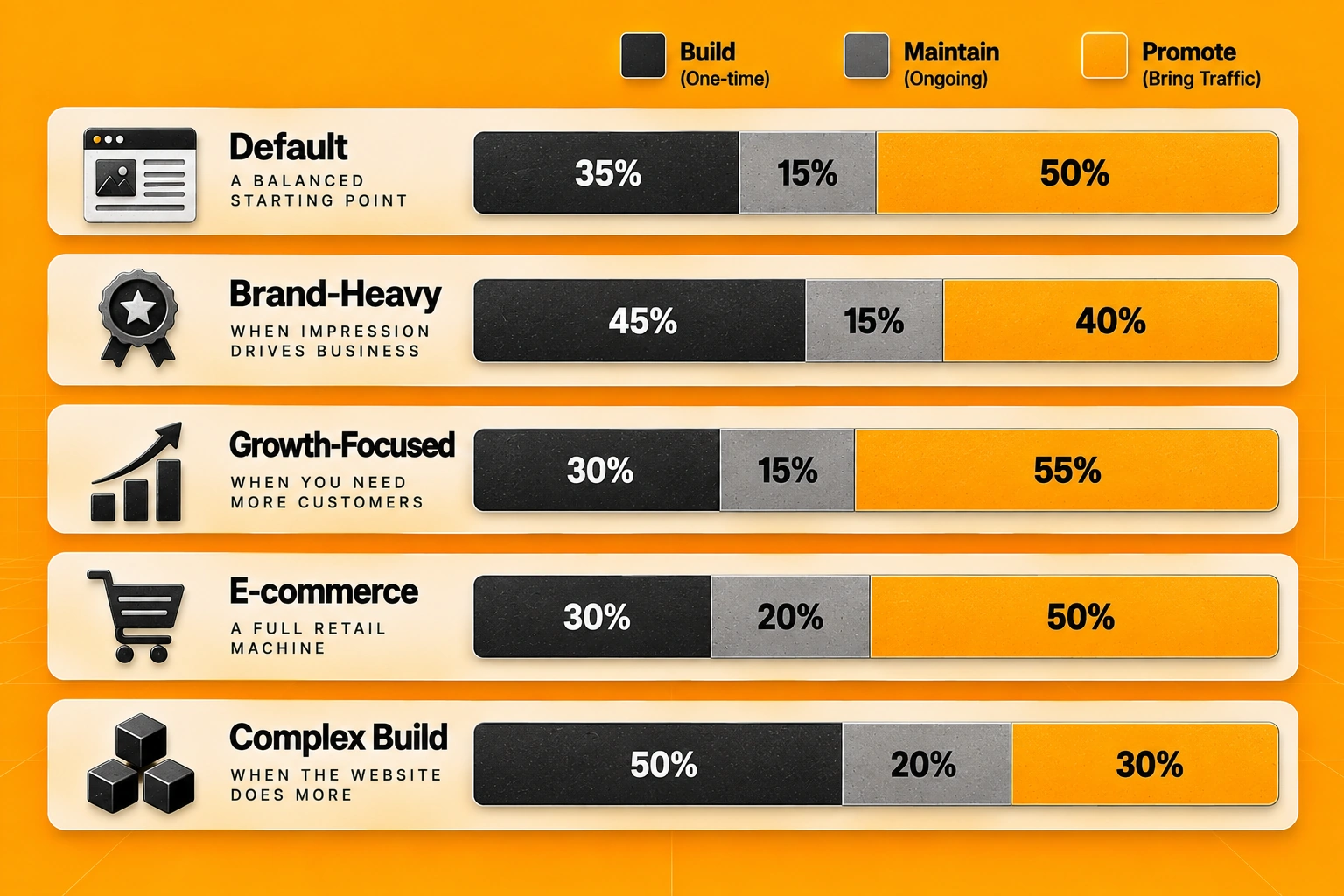
Shift the Build higher when the website has to impress before it converts
Premium brands. Luxury businesses. High-value B2B companies. Corporate brands.
When the website carries the brand's credibility when the experience of the website is the trust signal itself - the Build deserves more. A website that looks like a budget decision tells prospects exactly what kind of business you are.
Suggested shift: 45% Build / 15% Maintain / 40% Promote
The logic: if the website has to earn trust before it earns business, it has to be built to the standard the brand is trying to project.
Shift the Promote higher when you have a good site but need more customers
If the website is already solid and working, the bigger opportunity isn't redesigning it — it's getting more of the right people to it.
Suggested shift: 30% Build / 15% Maintain / 55% Promote
The logic: a good website performing at 40% capacity because it's not getting traffic is a more urgent problem than a website that could look slightly better.
For an e-commerce store weight both Maintain and Promote
An e-commerce website is the full retail machine: product, cart, checkout, payment, order, delivery. That machine has to be maintained. Products update, payments process, orders need to move. Maintenance isn't occasional here it's operational.
And promotion is existential: an online store with no traffic is a store with no customers.
Suggested: 30% Build / 20% Maintain / 50% Promote
For a complex website weight Build heavily, then Maintain
Booking systems. Client portals. CRM integrations. From Blog 02: sometimes what a business calls "a website" is actually software that happens to run in a browser. Software costs more to build. It costs more to maintain. The more the website does, the more both those buckets deserve.
Suggested: 50% Build / 20% Maintain / 30% Promote
Can the Website Pay for Itself?
This is where the budget conversation becomes genuinely interesting.
A customer doesn't always discover a business and immediately buy through the website. The real purchase journey often looks like this:
Google Search → Website → WhatsApp → Salesperson → Sale
or:
Instagram → Website → Store Visit → Purchase
or:
Referral → Website → Research → Enquiry → Contract signed
The website may never receive the final payment. But it influenced every single one of those sales.
So the question isn't always: "How many direct sales came from the website?"
The better question is:
"How much business did the website help make happen?"
Here's how to put a number on it.
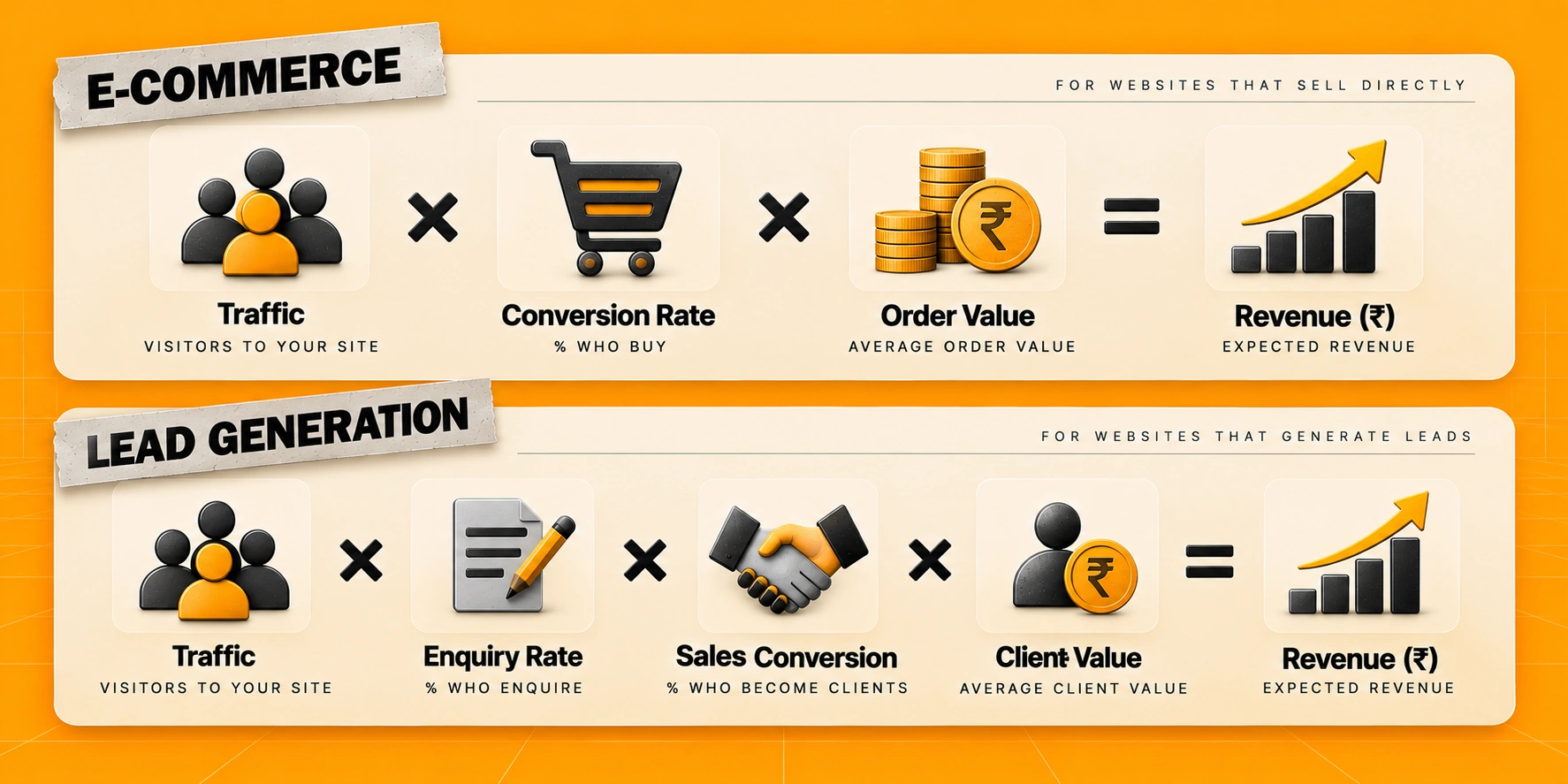
For a website that sells directly (e-commerce):
Traffic × Conversion Rate × Average Order Value = Expected Revenue
Picture this:
An online store gets 1,00,000 visitors. 2% buy something. Average order is ₹2,000.1,00,000 × 2% = 2,000 customers
2,000 × ₹2,000 = ₹40 lakh in expected revenueNow look at the total website investment - build, maintain, and promote combined - next to that number. If the investment is ₹6–8 lakh to influence ₹40 lakh, the case is clear.
For a website that generates leads (service business):
Traffic × Enquiry Rate × Sales Conversion × Customer Value = Expected Revenue
Picture this:
A service business gets 1,00,000 visitors. 3% submit an enquiry. 10% of those enquiries become paying clients. Each client is worth ₹50,000.1,00,000 × 3% = 3,000 enquiries
3,000 × 10% = 300 clients
300 × ₹50,000 =₹1.5 crore in influenced business
The website didn't close those contracts. A salesperson did. But it started every single conversation.
For an existing offline brand going online:
The website isn't starting from zero. It has existing customers, existing brand awareness, and existing demand it can now reach online.
Online Sales + Website-Influenced Offline Sales = Total Website Impact
A customer who finds a product on the website and buys it in-store the next day — that offline sale was website-influenced. Don't judge the website only by its direct checkout numbers.
Three Questions Before You Approve the Budget
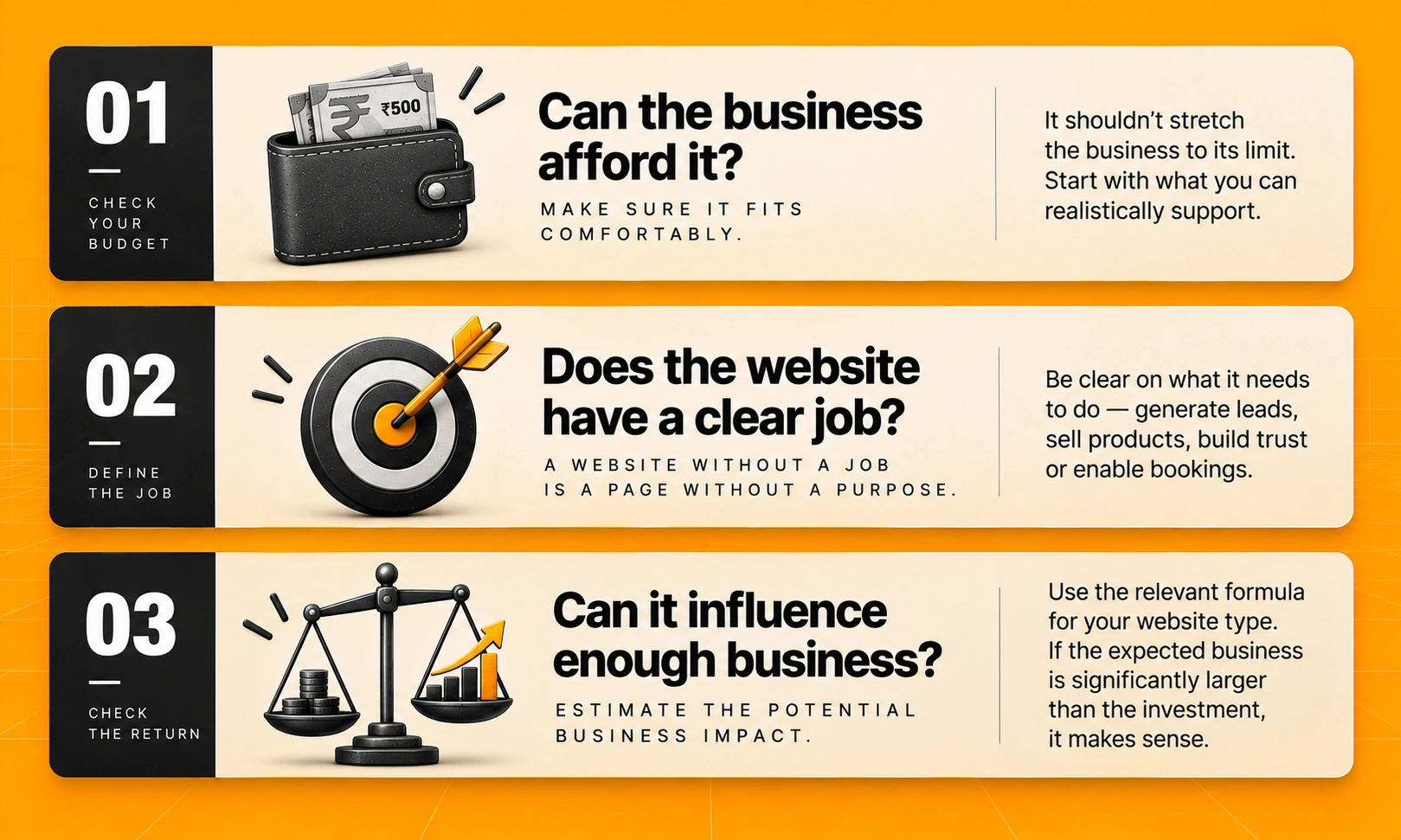
The formula gives you the range. These three questions tell you whether the range makes sense for the business right now.
Question 1: Can the business comfortably afford this?
The formula gives a sensible starting estimate — not a mandate. A website investment shouldn't stretch the business to its limit in the first year.
The number can be built toward. Start with what the business can genuinely support, focus the early investment on the most important bucket, and grow from there.
Question 2: Does the website have a clear job?
From Blog 02: a website without a job is a page without a purpose.
If you can't describe what the website needs to do for the business in one sentence — generate enquiries, sell products online, build brand credibility, enable client bookings — the budget conversation is premature. Get clarity on the job first.
Question 3: Can it realistically influence enough business?
Run the estimate. Use the version that matches your website type:
E-commerce: Traffic × Conversion Rate × Customer Value = Expected Revenue
Lead generation: Traffic × Enquiry Rate × Sales Conversion × Customer Value = Expected Revenue
Offline brand: Online Sales + Website-Influenced Offline Sales = Total Website Impact
If the expected business the website influences is significantly larger than the total investment, the investment makes sense.
If it doesn't add up - either adjust the budget down, or rethink the strategy before the money moves.
Pull It All Together - The 5-Step Framework
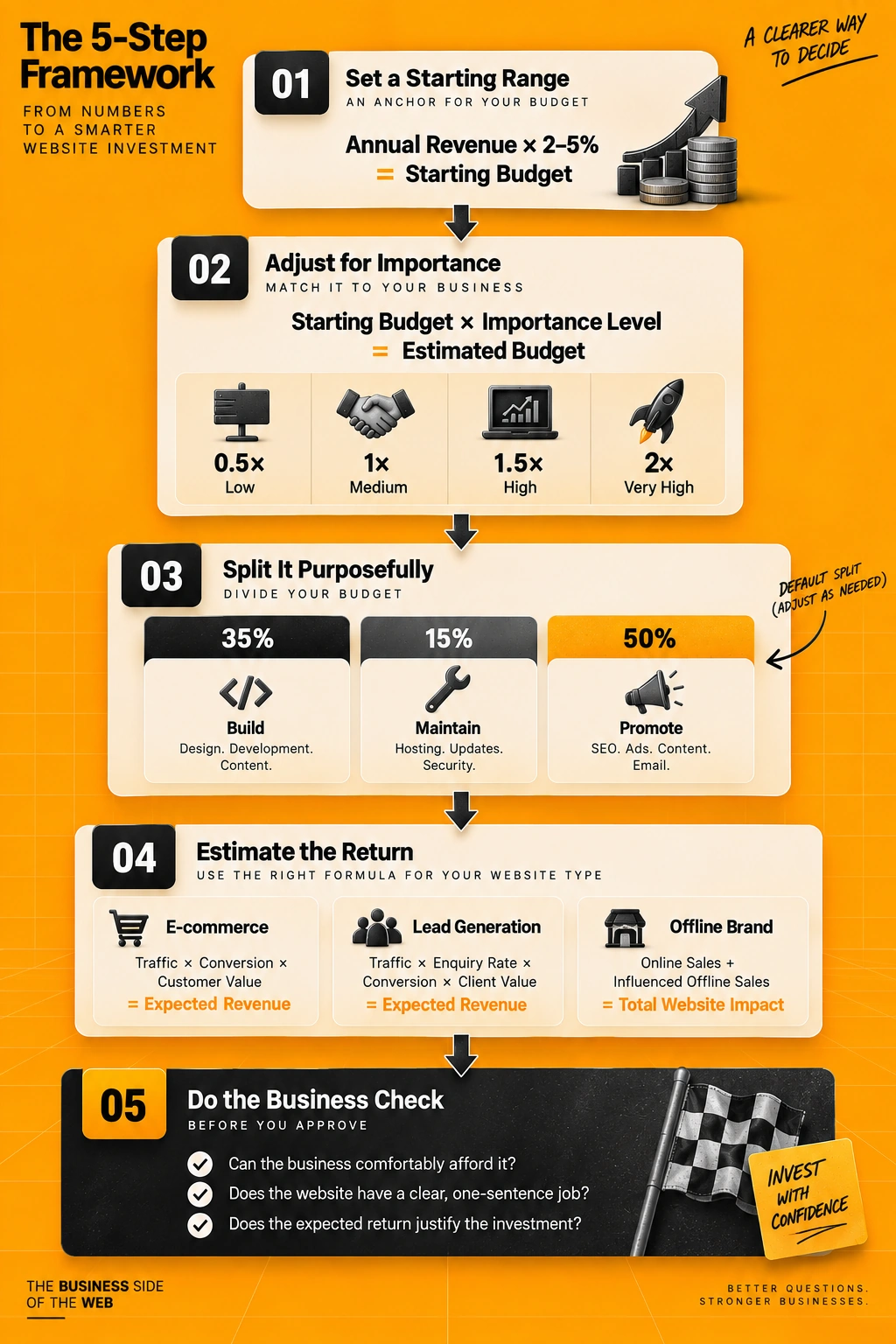
STEP 1 — SET A STARTING RANGE
Annual Revenue × 2–5% = Starting Budget
STEP 2 — ADJUST FOR IMPORTANCE
Starting Budget × Importance Level = Estimated Budget
(0.5× Low → 1× Medium → 1.5× High → 2× Very High)
STEP 3 — SPLIT IT PURPOSEFULLY
Build + Maintain + Promote
Default: 35% / 15% / 50%
Shift based on your website type and biggest gap.
STEP 4 — ESTIMATE THE RETURN
E-commerce: Traffic × Conversion × Customer Value
Lead Gen: Traffic × Enquiry Rate × Conversion × Value
Offline Brand: Online Sales + Influenced Offline Sales
STEP 5 — DO THE BUSINESS CHECK
Can the business comfortably afford it?
Does the website have a clear, one-sentence job?
Does the expected return justify the investment?


Comments