In Blog 02, we covered how to identify the type of website your business actually needs. This blog covers what that website costs, and why the price varies as much as it does.
Website development quotes in India can range from ₹8,000 to ₹1,50,000 for what looks like a similar project on paper. That range isn't random. It comes down to four separate cost sectors that different developers and agencies bundle, skip, or price differently. Once you can see those four sectors clearly, comparing quotes becomes a lot simpler.
Myth: WordPress Means a Cheaper Website
A common way of comparing website quotes is to decide the platform first:
"Make it in WordPress, so it should be cheaper."
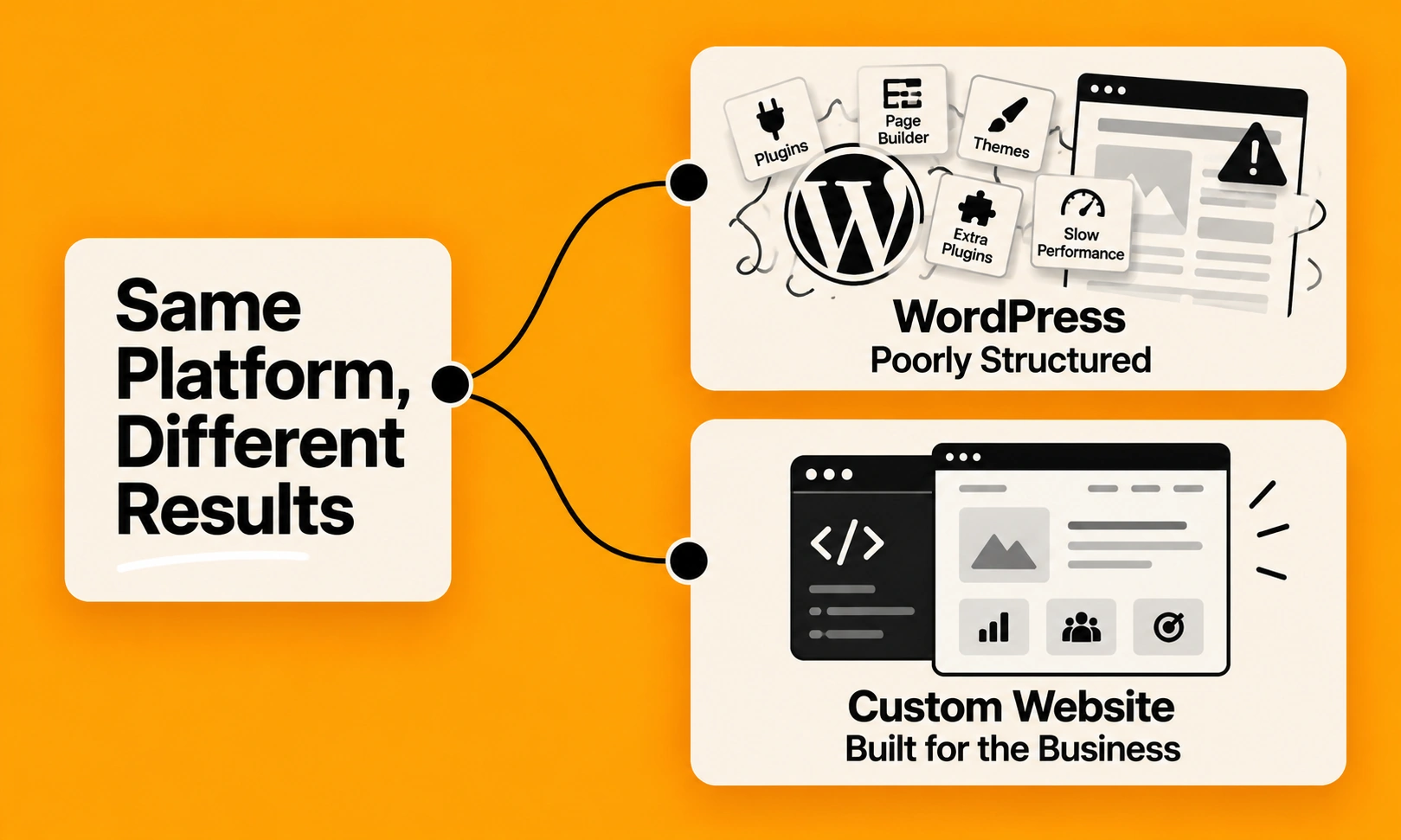
But the platform does not decide the cost of a website.
What you need the website to do does.
A WordPress website can be poorly structured, difficult to maintain, and almost completely dependent on plugins. But that is not a limitation of WordPress itself. It is often a result of how the website has been built at a cheap price.
An experienced developer can create a website and dashboard around your actual requirements, showing you only the things you need to manage.
The same applies to websites built with other technologies. A developer can use existing code, tools and modern AI-assisted development to build exactly what the project requires instead of creating everything from scratch.
So two websites can both be made in WordPress and have completely different costs just as two custom-coded websites can have completely different costs.
The important question is not
"Which platform is cheaper?"
but"What does my business actually need?"
E-Commerce Is Different
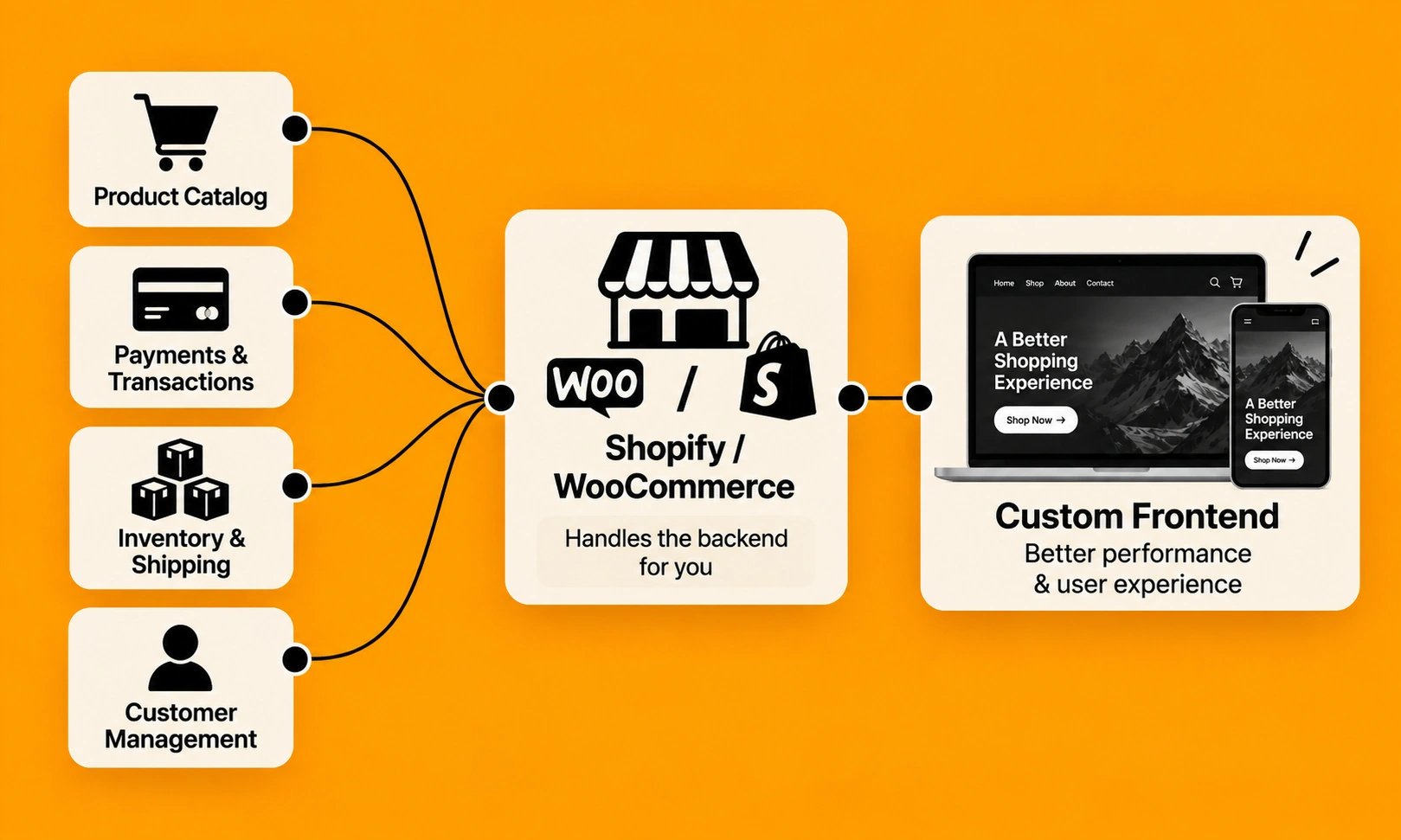
E-commerce is one important exception. Building a complete online store from scratch means developing and testing products, carts, checkout, payments, orders, customers, inventory and many other systems.
That is why platforms such as
Shopify and WooCommerce
are often a practical choice. They handle the complex e-commerce system, while the website can still be customised with your own design and functionality.You can even have a completely independent frontend with a headless setup while the e-commerce platform manages the backend.
The platform should be chosen based on the requirements of the business, not simply because one platform sounds cheaper.
The Three Cost Sectors of a Website
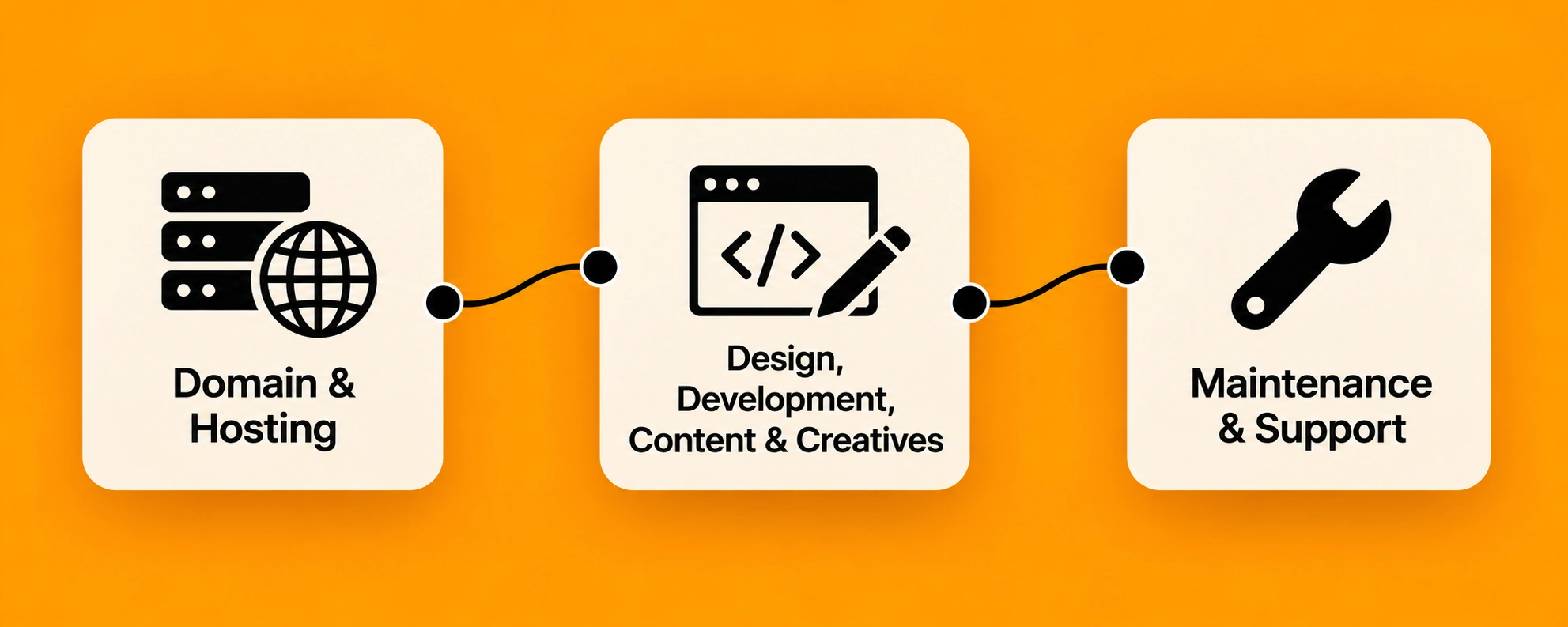
Every website budget in India is made up of these four parts, whether or not the person quoting you breaks them out:
Domain and Hosting
- It is the recurring cost of having an address and a server, paid to third-party platforms regardless of who builds your site.Design, Development, Content and Creatives
- It is the one-time cost of building the website itself: the code, the structure, the logic, the layout. Also the words, images, and messaging that go into that structure .Maintenance and Support
- It is the ongoing monthly cost of keeping the site secure, updated, and working after it's live.
The rest of this blog goes through each of these in order, with actual numbers.
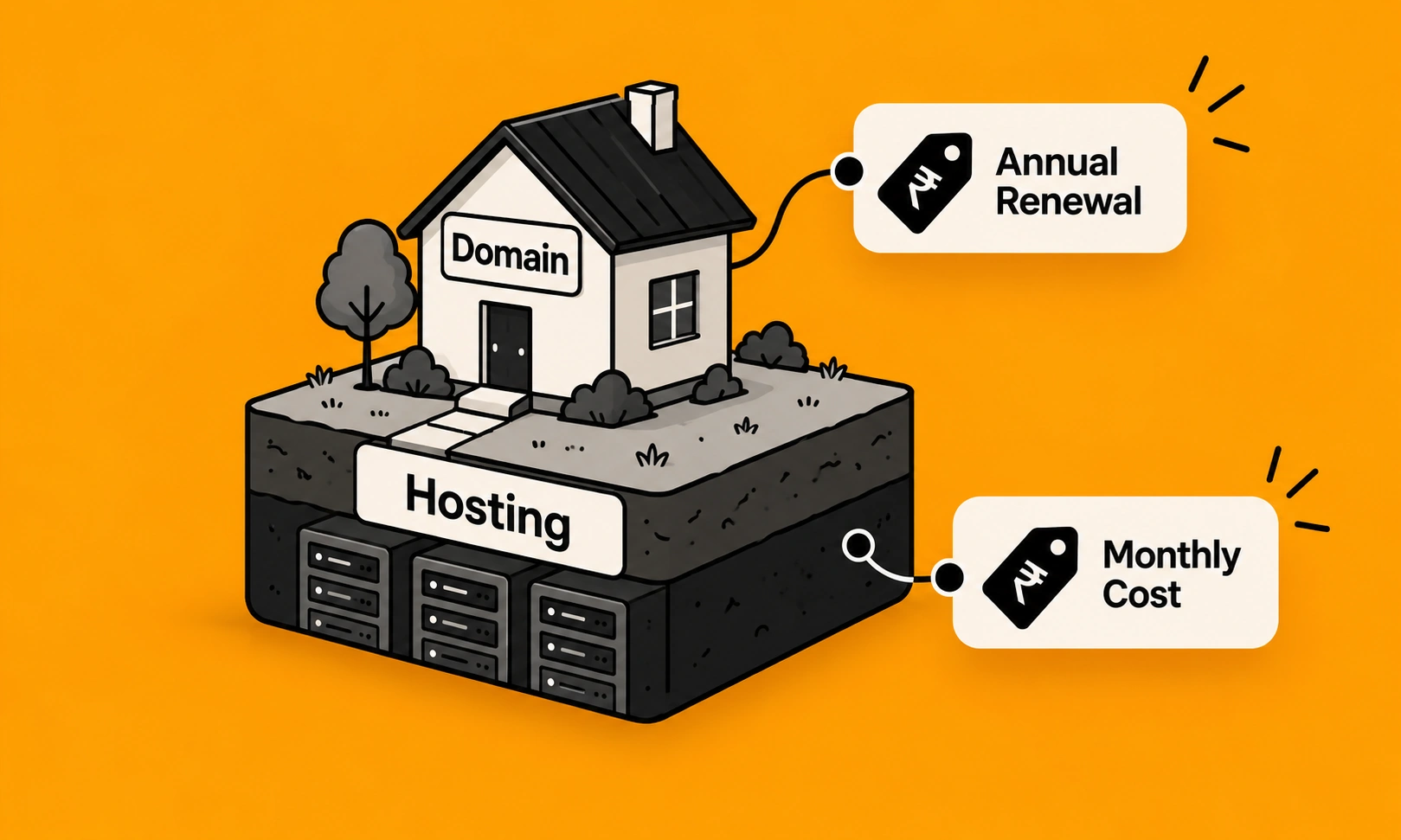
A.1) Domain Costs
Before building a website, remember that domains and hosting incur ongoing fees - they are not “free” once you build the site. A domain name (like yourbusiness.com or .in) is leased on an annual basis. Registrars often run deep first-year discounts; for example, GoDaddy advertises a .com domain for ₹1 for the first year only if you buy 3 years upfront. However, that is just a promotional rate. The renewal price (what you pay after the initial term) is what really matters for budgeting. In practice, .com renewals in India tend to be on the order of ₹1,000–1,500 per year, and .in renewals around ₹700–₹800 per year. For instance, BigRock’s price list shows a .com renewal at ₹1,199/yr and a .in renewal at ₹729/yr. As one GoDaddy help article explains, domains remain yours only so long as you keep paying the annual fee, so it’s safer to assume the ₹1 first-year deal is temporary and plan for the much higher renewal rate.
A.2) Hosting Costs in India
Web hosting is the service that keeps your site live on the internet, and it’s a separate recurring cost. Shared hosting (multiple sites on one server) can be very cheap if you commit long-term. For example, Hostinger’s Premium shared-hosting plan is currently advertised at ₹149/month if you prepay 48 months (₹7,152 total). However, after the initial term it renews at ₹449/month (about ₹5,388 per year). Their lowest plan is even cheaper – the Single plan is ₹69/month (4-year prepay) and renews at ₹289/month. The key takeaway is that promo prices (like ₹149) require multi-year commitment, and real renewal rates tend to be in the ₹350–650/month range for business-grade plans.
For heavier traffic or applications, shared hosting may not suffice. Cloud/VPS hosting (where you rent a virtual server) costs more but offers scalability. For example, DigitalOcean’s entry-level “Droplet” starts at $4 per month (approximately ₹360–400/month depending on exchange rates), which comes with 1 GB RAM and 1 vCPU. Higher-end droplets (with more RAM/CPU) go up in price (e.g. about $6–12 for 2–4 GB RAM). In rupee terms, a basic $4–$6 monthly server is roughly ₹4,200–₹6,000 per year. Cloud servers are generally billed per hour with a monthly cap, but as DigitalOcean notes bundled plans start at “as low as $4 per month”.
A.3) E-commerce Platform & Transaction Fees
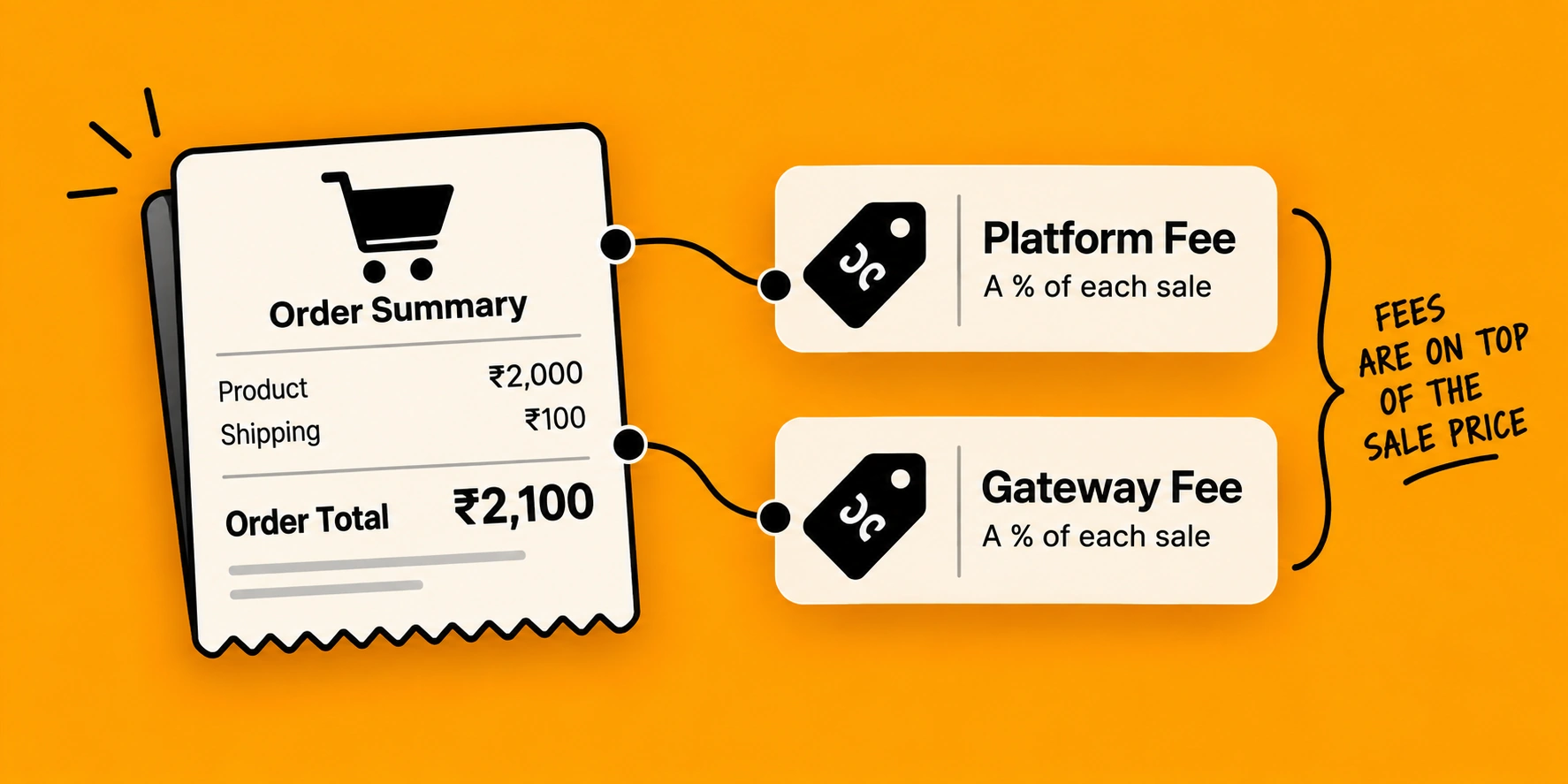
If you’re building an online store on a hosted SaaS platform (like Shopify, Wix, Squarespace), remember that hosting is included in the subscription – you don’t buy separate hosting. For example, Shopify’s Basic plan in India is ₹1,499/month and that covers the store hosting, templates, SSL, etc. (Similarly, Wix’s business plans run on the order of ₹1,500–₹2,000/mo).
However, these platforms charge per-transaction fees on top of the monthly rate. Shopify’s Basic plan imposes a 2% fee on each sale if you use a third-party payment gateway (its Grow plan charges 1%, Advanced 0.6%). In other words, even after paying ₹1,499/mo for Shopify, you pay an extra 2% of each order value to Shopify unless you use Shopify Payments.
On top of that, your payment processor charges its own fees. In India, popular gateways like Razorpay or Stripe typically charge about 2% + GST per transaction. Razorpay’s pricing page explicitly states “Razorpay charges 2% + GST per transaction” for all payment modes (cards, UPI, wallets, netbanking). So a sale on a Shopify + Razorpay setup could incur roughly ~4% of the order value in fees (2% to Shopify + 2% to Razorpay, plus GST).
Key points: Don’t assume “Shopify pricing” covers everything. Hosting is bundled (so you won’t pay a separate ₹500–1,000/mo host if you use Shopify), but transaction fees still apply. Likewise, if you built a store on WooCommerce (WordPress) or a custom site, you’d pay your own hosting plus the gateway fees (~2%). In any case, plan for those payment charges.
Summary of typical costs:
Domain registration often starts near ₹1 (promo) but renews around ₹1,000–₹1,500/year. Shared hosting (e.g. Hostinger) can be as low as ₹69–₹149/mo on long-term deals, renewing around ₹289–₹449/mo. Cloud servers (DigitalOcean) start at ~$4/mo (≈₹4k/yr). And SaaS store platforms like Shopify cost ₹1,499–₹5,599/mo, plus ~2% (Shopify) + 2% (gateway) per sale. All these figures are drawn from official sources, so you can use them for realistic budgeting.Sources: Official pricing and FAQ pages from GoDaddy, Hostinger, DigitalOcean, Shopify, and Razorpay have been used to compile these numbers.
B) Website Pricing in India by Type
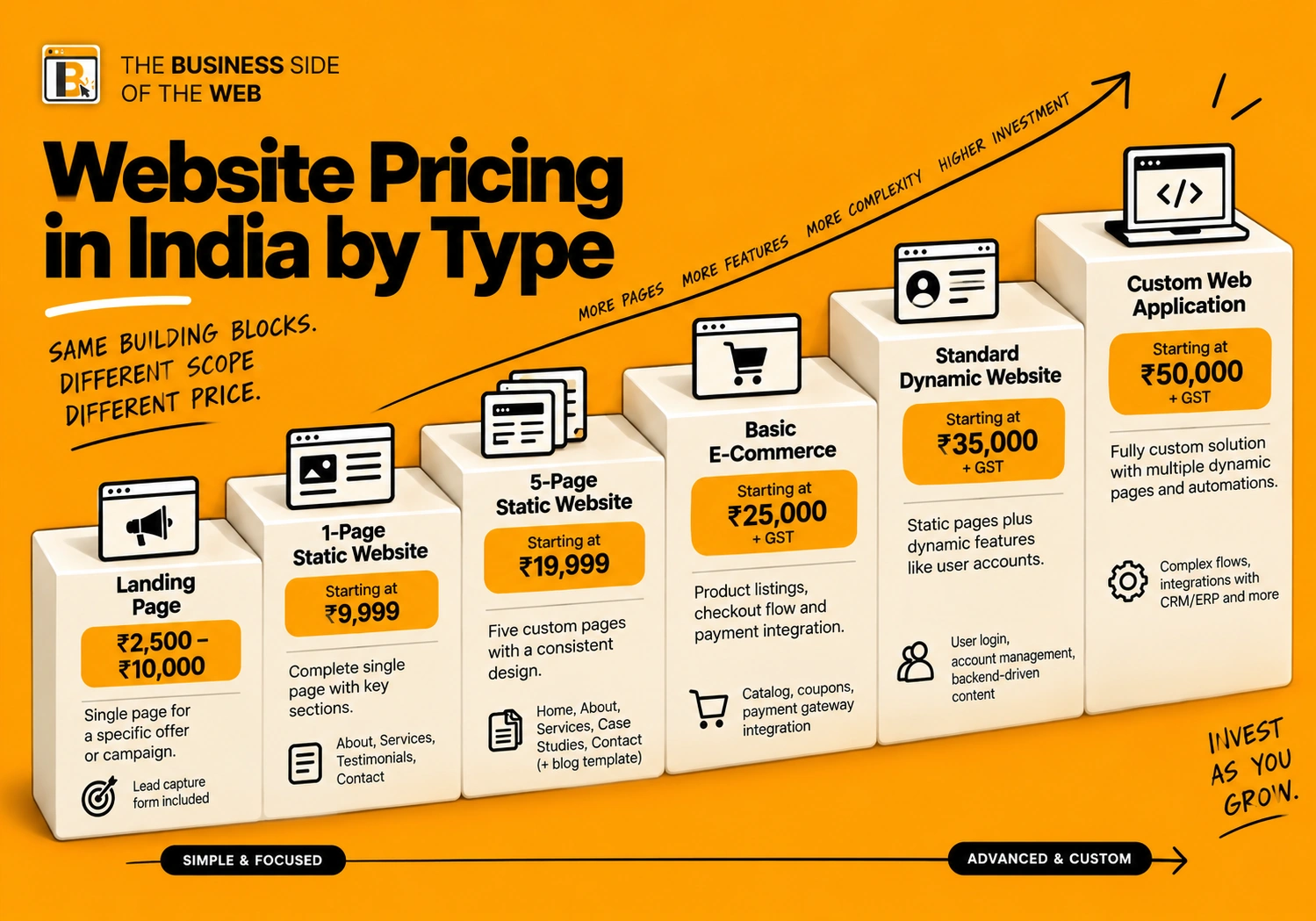
These prices cover the Design, Development, and Content sectors of a website — domain, hosting, and ongoing maintenance are separate costs, covered above and below. Each price point below isn't an arbitrary number. It's a bundle of the same individual components — pages, forms, and sometimes automations - priced together, which is what the section further down breaks down in more detail.
Landing Page Cost
₹2,500 – ₹10,000
A landing page is a single page built for one specific offer, ad campaign, or product launch, and it's lighter in scope than a full custom website. The price depends on how much design work goes into it, and it includes one lead-capture form by default. Where it lands in that range moves up if the form is connected to automations - for instance, sending an instant WhatsApp reply or a CRM entry the moment someone submits it.1-Page Static Website Cost
Starting at ₹9,999
This is also a single page, but built with more depth than a landing page - a Hero section, About, Services, Testimonials, and a contact form connected to your email, all designed to work together as a complete digital presence rather than a single campaign push. The added sections and the more thorough content and design work are why this starts higher than a basic landing page.5-Page Static Website Cost
Starting at ₹19,999
This is effectively five individual static pages - Home, About Us, Services, Case Studies, and Contact - bundled together, each with its own layout, along with a repeatable template for future blog or news pages and up to two custom lead forms wired to route data correctly. The price reflects five pages' worth of design and content work happening together, rather than one page repeated five times.Basic E-Commerce Website Cost
Starting at ₹25,000 + GST
This moves beyond static pages into functionality that behaves like a dynamic page - product listings that pull from a catalog, a checkout flow, coupon logic, and a payment gateway integration, which works much like the automations covered later, connecting your store to an external payment and order system.Standard Dynamic Website Cost
Starting at ₹35,000 + GST
A homepage and static pages, plus genuinely dynamic pages - user login systems, account management, and content pulled live from a backend server. Each dynamic page in this build carries a higher cost than a static one, for the same reason a single dynamic page costs more on its own.Custom Dynamic Web Application Cost
Starting at ₹50,000 + GST
This is the largest bundle - multiple dynamic pages, several user input flows, and automation flows connecting to systems like an ERP or CRM. In practice, it's several of the individual components explained below, combined into one build.Another point worth keeping in mind is that these figures apply to a fully custom build. Template-based websites can cost less, but they come with fewer options for customization down the line.
Why Website Prices Vary in India
The range in pricing comes down to what's actually included at each price point, not inconsistent pricing across the market.
A website priced around ₹5,000 is typically a pre-made template sold to many other buyers, with the logo and text swapped in. A website priced at professional agency rates includes secure hosting configuration, lead-capture forms that route correctly, mobile-responsive architecture, and code built to handle multiple visitors at once without breaking.
For example, one client had paid ₹12,000 for a freelance e-commerce setup that looked complete on the surface. The payment gateway, however, didn't work correctly on mobile browsers. This went unnoticed for a few months, during which mobile orders simply weren't going through. If the underlying build has issues, sending traffic to it - through ads or otherwise - tends to surface those problems faster rather than fixing them.
This is also why "how much for a 5-page website" isn't a complete question. A 5-page static brochure site and a 5-page e-commerce store are built very differently, even though they look similar in scope. What's being paid for is the capability behind the pages, not the page count itself.
Design, Development and Content Cost Breakdown
Design and Development, and Content and Creatives, are grouped together here because almost nothing gets added to a website without both a build component and a content component at the same time. A new page needs code, a layout, and copy together - development, content, and design aren't separate purchases stacked on top of each other, they're three parts of the same piece of work.
That's why a static page - a simple, single-purpose page like the "Company History" example used earlier - runs about ₹3,000. A dynamic page, one that pulls live data such as real-time stock from a database, costs more to build because of the backend logic involved, closer to ₹4,000. A user input flow, like a form that saves to a database and triggers a confirmation email, adds roughly ₹1,500.
Automation flows work a little differently, since their cost depends on how many systems they connect to rather than a flat rate. A simple automation, like sending an email alert the moment a form is submitted, starts around ₹5,000. Add a CRM entry and a WhatsApp confirmation to that same flow, and it moves closer to ₹8,000–₹10,000. A more layered automation touching several systems at once - CRM, WhatsApp, email, and inventory updates, for instance - can go beyond ₹15,000.
This is also where the landing page cost mentioned earlier connects back: a ₹2,500-₹10,000 landing page already includes one form, and its cost rises the same way by adding automations to that form, not by rebuilding the page itself.
One more factor to consider is that these are baseline figures for straightforward requirements. A highly custom design or additional integrations will generally push the cost higher within any of these additions.
Total Website Cost Formula
Total Cost = Base Package (Design + Development + Content) + Extra Pages + Custom User Flows + Automations
, in addition to the annual Domain and Hosting cost covered earlier.This formula is useful to keep on hand when comparing quotes, since it shows what's actually being priced at each stage rather than a single bundled number.
C) Maintenance and Support Costs
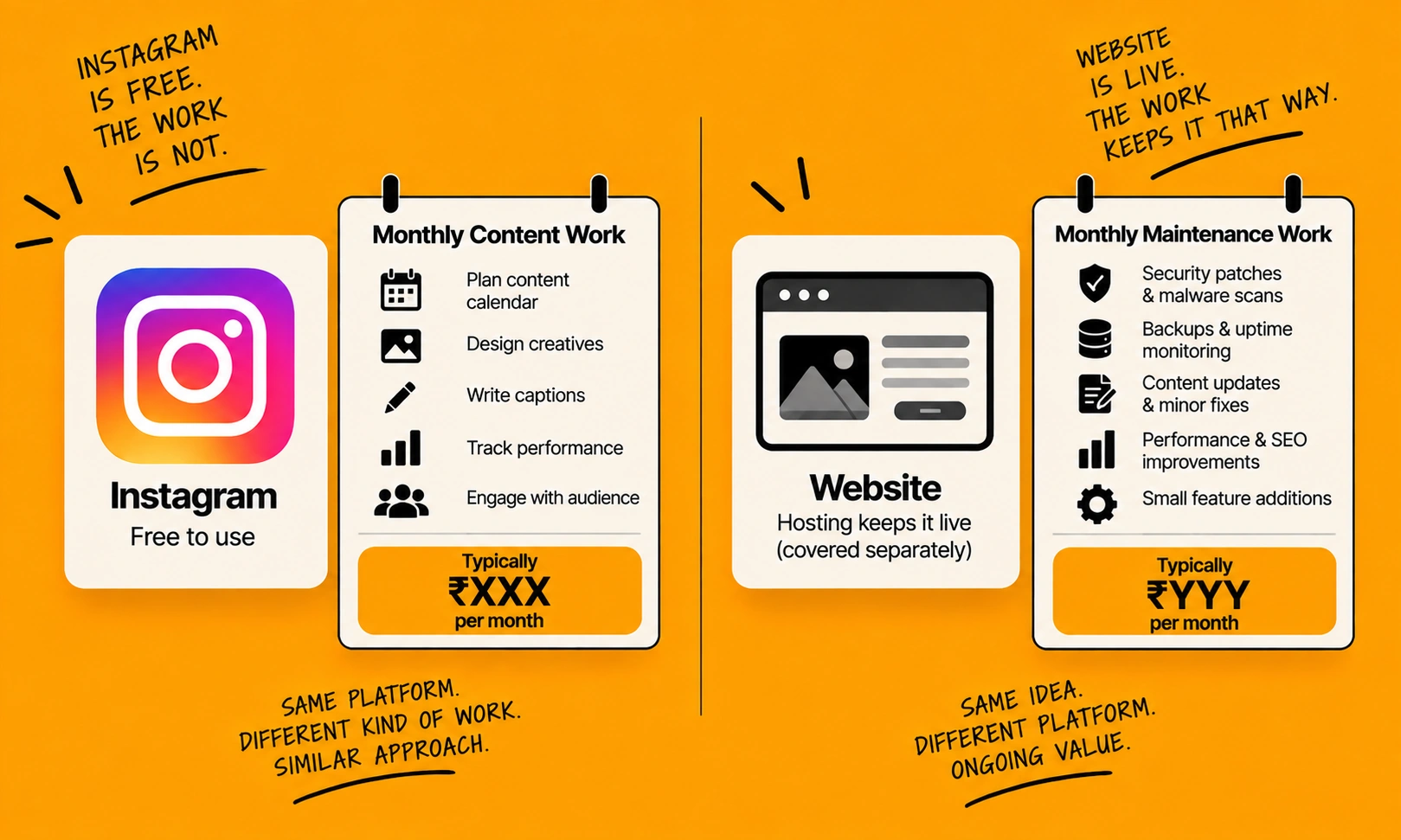
Maintenance is priced similarly to how social media management is priced. Instagram itself is free to use - what costs money is paying someone to plan posts, write captions, design creatives, and track performance on it every month. A website works the same way: hosting is a fixed cost already covered earlier, and maintenance is the monthly work needed to keep the site running and current.
Maintenance and support costs usually fall somewhere between ₹1,500 and ₹10,000 or more per month, and where a website lands in that range comes down to how many activities are actually being carried out each month, not a fixed plan someone is sold into.
At the lower end, around ₹1,500 to ₹2,500 a month, this typically covers the basics: security patches, backups, uptime monitoring, and malware scans with no active changes being made to the site itself.
In the ₹3,000 to ₹5,000 range, it usually adds small content updates and minor bug fixes on top of those basics, so the website is being lightly managed rather than just watched.
Above ₹6,000 a month, this tends to include performance and SEO adjustments, monthly reporting, and small feature additions - closer to actively running the website than simply keeping it online.
Another factor to consider is that maintenance needs tend to increase as a website grows in traffic and features, so the right range can shift over time rather than staying fixed.
Summary
Website pricing in India splits across four sectors: Domain and Hosting as a recurring cost, Design and Development as the build itself, Content and Creatives as what fills that build, and Maintenance and Support as the ongoing monthly work after launch. Each of the website types above carries its own baseline price because each one requires a different combination of these sectors, and any custom addition on top of a package follows the same page, flow, and automation logic shown earlier.
Before development actually begins, there are a few assets and decisions worth preparing in advance, since missing them is a common reason projects stall regardless of budget. That's covered next.



Comments