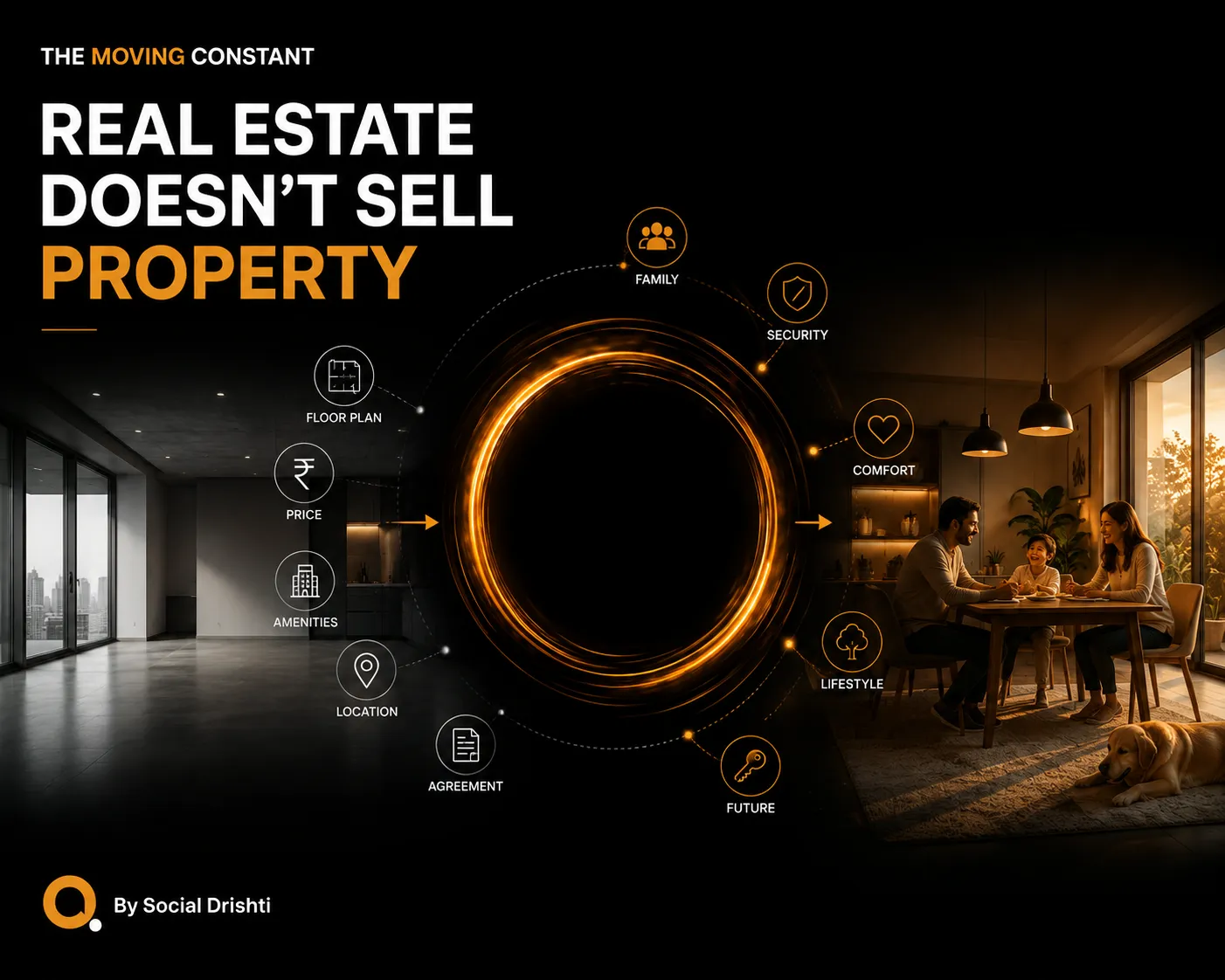
Most real estate developers and agents believe they are in the property business. They focus their marketing on square footage, granite countertops, and drone flyovers.
This is a fundamental misunderstanding. You are not selling bricks and mortar; you are selling financial security, risk mitigation, and lifestyle elevation to people making the biggest purchase of their lives.
If you build your entire marketing strategy around showing off empty rooms without building developer pedigree or agent authority, your competitors with a stronger brand presence will always win even if their properties are inferior.
Why does a boutique agency with a smaller portfolio close high-ticket deals effortlessly, while your massive luxury housing project struggles to get qualified site visits?
In Part 1: There Is No Universal Marketing Strategy, we established that human psychology remains constant, but applying a low-friction D2C playbook to a complex, high-risk sale breaks the system.
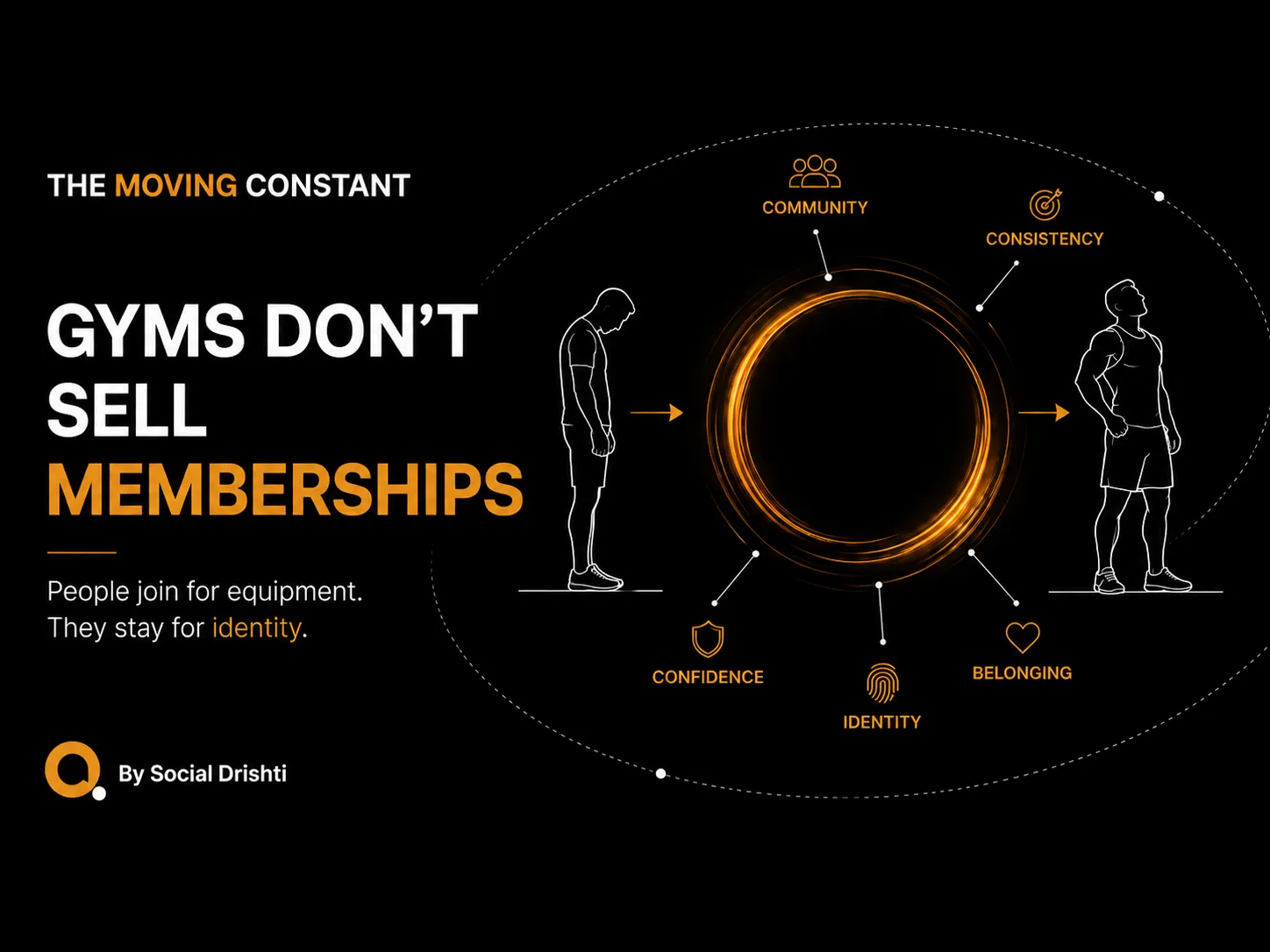
In Part 2: The Gym Marketing Playbook, we explored how local services sell identity.
For real estate, the moving constant shifts entirely to High-Ticket Trust.
The Illusion of “More Leads”
“Posting daily is not your final solution.”
Many real estate agents believe that flooding Instagram with generic property listings, trending audio, or motivational quotes will magically fill their sales pipeline. It won’t. It simply adds noise to an already saturated digital space.
A Mini-Story:
A real estate developer came to us after spending ₹3L on broad lead-generation ads across Facebook and Instagram.Thousands of clicks. Hundreds of form fills. Zero qualified site visits.
The problem wasn’t the ads.
The ads showcased luxury, high-ticket floor plans to a massive, unqualified audience. The content drove curiosity from dreamers who could never afford the down payment, but failed to build trust with the actual high-net-worth buyers living within the target demographic.
“This is where interest dies.”
When 97% of home buyers start their search online, your digital presence isn’t just a brochure; it is the ultimate filter. If your marketing doesn’t actively disqualify the wrong buyers while deeply educating the right ones, you are burning cash.
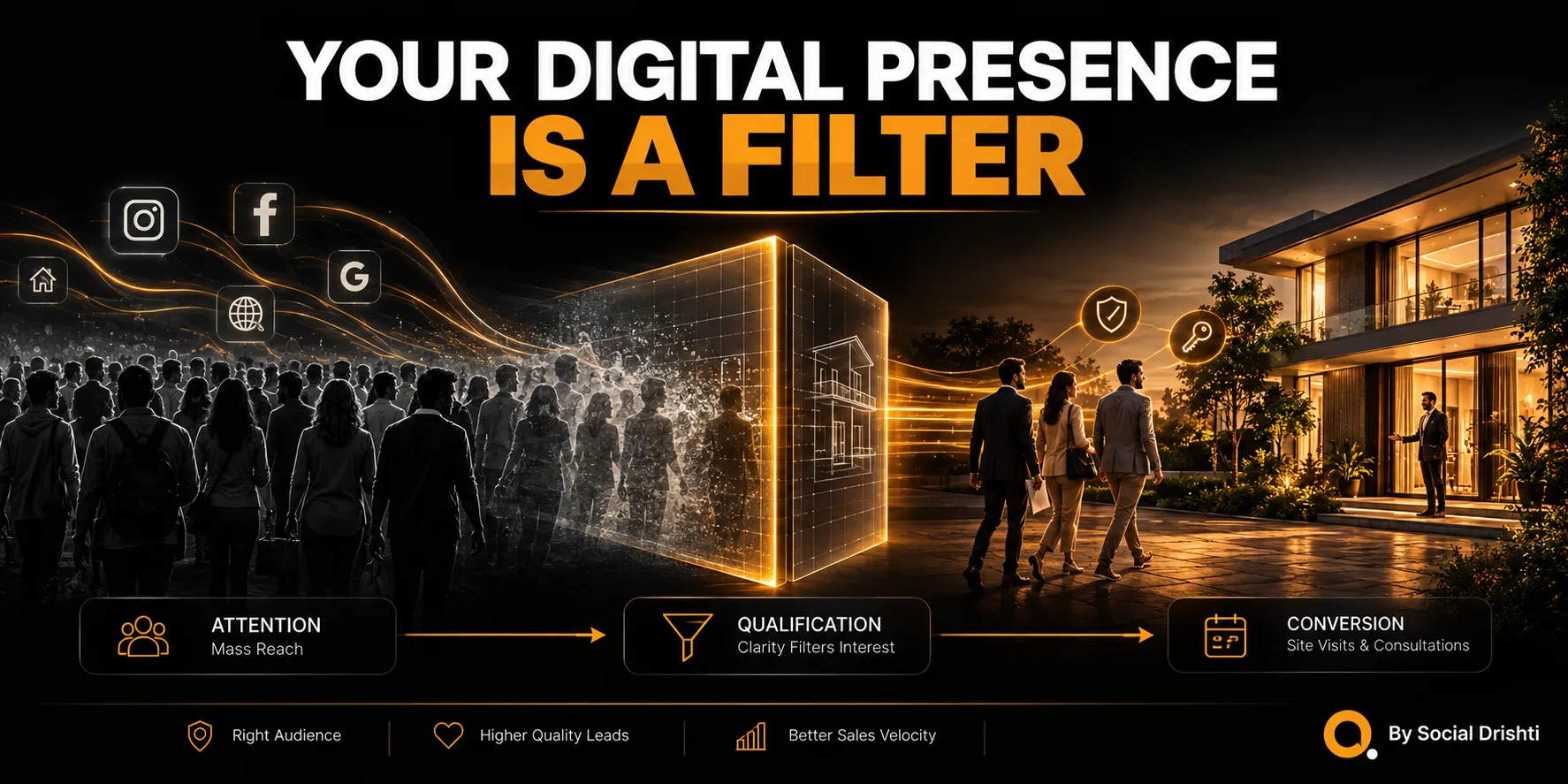
The Framework: Traffic → Trust → Transaction
To build an engine that actually converts in real estate, we apply our core framework: Traffic → Trust → Transaction. However, the execution profile here requires a hyper-specific approach.
1. Traffic (The Moving Target)
“This is where most businesses lose money.”You do not need a million impressions; you need high-intent visibility. The right marketing choices mean nothing if you deliver them to the wrong audience.
Are you targeting first-time home buyers or those looking to buy upscale commercial properties? If you use the same messaging for both, you will fail.
The Shift in Channel: Broad social media targeting is for awareness. For conversion, shift your budget to high-intent local SEO, property portals (Zillow, Realtor.com, Domain), and geo-targeted search ads.
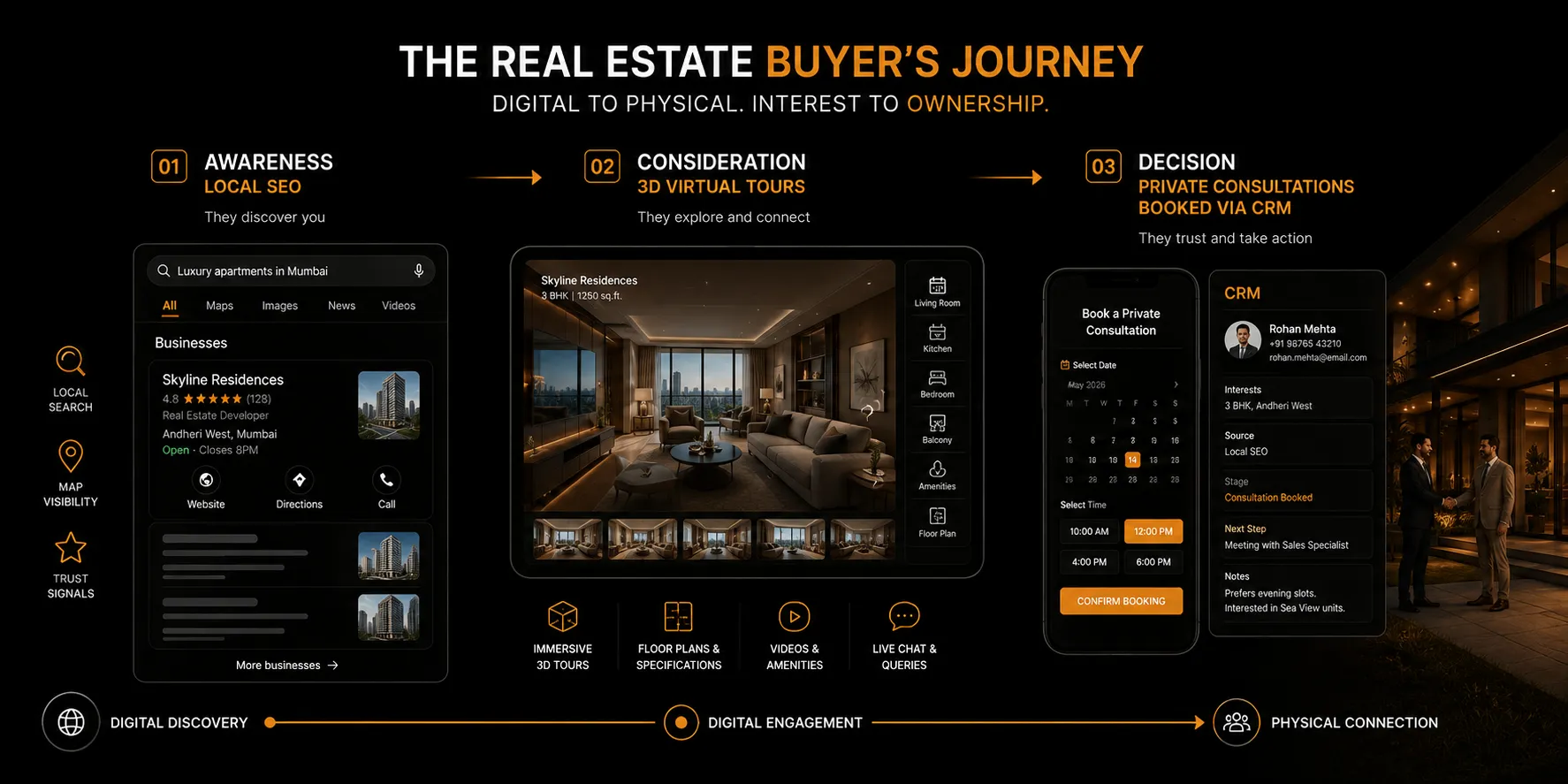
The Buyer’s Journey: Traffic must be captured at multiple stages.
Awareness Stage: Educational blog posts, neighborhood guides, and market reports.
Consideration Stage: Property showcase videos, client testimonials, and retargeted ads.
2. Trust (The Constant)
“The 3C Problem: Clarity, Credibility, Conversion”In real estate, social proof isn’t a nice-to-have; it is the exact evidence required to alleviate a buyer’s massive financial anxiety. You are asking someone to part with their life savings.
“You’re not unlucky. You’re unclear.”
If your website consists of blurry smartphone pictures and vague descriptions, you instantly lose credibility. To win, you must implement a strict Content Hierarchy:
Basic: Standard photos and written descriptions (The bare minimum—often ignored).
Intermediate: Professional HDR photography, 2D floor plans, and stabilized walk-through videos.
Advanced: Aerial drone footage highlighting the neighborhood and proximity to amenities.
Elite: Immersive Matterport 3D Digital Twins, interactive Matter tags (highlighting specific finishes or appliances), and virtual open houses.
Give the buyer absolute transparency before they ever step foot on the property. When a buyer can virtually walk through a home at 2 AM on their iPad, you have built trust without lifting a finger.
3. Transaction (The Offline Handover)
“If you had to change one thing, change this.”
Stop asking for a “Buy Now” equivalent on your digital channels. The conversion event in real estate is not a digital checkout, it is a Scheduled Private Consultation or an In-Person Site Visit.
Remove the friction to book that specific event.
“This is where it gets interesting.”
The transaction is just the beginning of the Retention Stage. Real estate marketing shouldn’t just be about customer acquisition. Regular communication, email newsletters containing market updates, and automated check-ins nurture existing clients into long-term partners. This is how you build a referral engine.
15 High-Impact Marketing Strategies for Real Estate
To operationalize the moving constant, you need a diverse, multi-channel approach. Here is how top-tier developers and agents deploy their resources:
Visual & Immersive Content
- Professional Staging & Photography: Never list an empty, unlit room. Staging creates emotional attachment.
- Aerial & Drone Footage: Sell the location, not just the lot. Show the proximity to schools, parks, and transit.
- Immersive Digital Twins: Utilize tools like Matterport to create 3D virtual tours, keeping buyers on your listing up to 300% longer.
- Virtual Open Houses: Host live-streamed walkthroughs on social platforms to capture out-of-state or international investors.
- Search & Content Marketing
Implement a Hyper-Local SEO Strategy: Optimize your website for terms like “luxury condos in [Neighborhood]” rather than just “real estate agent.” - Lead Magnets: Offer free, high-value resources in exchange for emails (e.g., “The 2026 Guide to Buying Property in [City]”).
- Educational Content: Demystify the buying process. Create content explaining mortgage rates, zoning laws, or negotiation tactics.
- Email Segmentation: Don’t send a $2M villa listing to a first-time buyer list. Segment your CRM by budget, timeline, and family size.
- Leverage Visual Platforms: Use Instagram and Pinterest for high-end aesthetics, and LinkedIn for commercial real estate and investor networking.
- Build Local Collaborations: Partner with local interior designers, mortgage brokers, and contractors for cross-promotion.
- Sponsor Local Events: Real estate is a hyper-local game. Sponsoring a community event builds offline trust that translates to online searches.
- Print Advertisements & Billboards: In luxury markets, high-quality print in premium lifestyle magazines still carries immense prestige.
- Direct Mail Campaigns: Targeted postcards to specific zip codes (“Just Sold in Your Area”) remain highly effective for generating seller leads.
- Strategic Portal Posting: Ensure your listings are syndicated correctly on major portals with complete data to trigger algorithmic boosts.
- Structured Referral Programs: Incentivize past clients to recommend you. A warm introduction bypasses the entire top-of-funnel marketing journey.
“If everything looks important, nothing converts.”
Do not try to execute all 15 strategies tomorrow. Pick the three that align with your specific target audience and master them.
How to Audit Your Operational Engine
If your follow-up process is neglected, your branding is inconsistent, or your landing pages aren’t mobile-optimized, turning on digital ads will only drain your bank account.
Before launching your next campaign, audit your Key Performance Indicators (KPIs):
- Lead Generation: Are you tracking Cost Per Lead (CPL) by specific channel?
- Website Metrics: Is your bounce rate suspiciously high? Are users actually clicking into your 3D tours?
- Bottom Line ROI: Track Customer Acquisition Cost (CAC) against Customer Lifetime Value (CLV).
Use lead management software (like Salesforce, HubSpot, or Zoho CRM) to ensure no inquiry falls through the cracks. If an automated email doesn’t go out within 5 minutes of a form submission, you have likely lost the lead to a faster competitor.
The Bottom Line
Real estate marketing is a dynamic balance between offline relationship building and cutting-edge digital transparency. It is about understanding that a buyer’s digital experience with your brand must flawlessly match the premium nature of the physical property you are selling.
Build a clear, credible, and visually stunning digital experience first. Establish your pedigree. Anticipate the buyer’s anxiety and answer it with unquestionable proof.
Only then do you turn on the traffic.
“Start here.”
The Road Ahead
Marketing is not a static set of rules to be memorised and applied blindly. It is a dynamic balance between what remains unchanged- human behaviour and what is constantly moving - the tactical platforms we use to reach them.
In the upcoming parts of The Moving Constant, we will dive deep into specific sectors to deconstruct exactly how these channels should be configured.
Part 1: There Is No Universal Marketing Strategy
Part 2: The Gym Marketing Playbook (The Identity and Community Playbook)
Part 3: The Real Estate Marketing Playbook (The High-Ticket Trust Engine) -> You are here
Part 4: The B2B Marketing Playbook (The Logic, Risk, and Career Security Equation)
Is your real estate marketing strategy aligned with your property portfolio?
We provide comprehensive, human-reviewed strategic audits. A senior growth strategist from our team will evaluate your current channels, website structure, visual content hierarchy, and CRM integration to identify gaps where your strategy might be misaligned with your target buyer.
→ Request a Strategic Audit
Comments