Most B2B companies market like they are speaking to a spreadsheet.
They build campaigns around feature lists, API integrations, and technical jargon, assuming their buyers are purely rational entities making purely logical decisions.
This is a fundamental misunderstanding. You are not selling software, consulting, or machinery. You are selling financial security, risk mitigation, and career survival.
If you build your entire marketing strategy around sterile “professionalism” and 50-page whitepapers, you are fighting a losing battle. Your competitors can always claim a faster processor, a cheaper license, or a slightly better dashboard.
Why does a disruptive startup with a smaller feature set effortlessly bypass your legacy procurement process and close the enterprise deal?
In Part 1: There Is No Universal Marketing Strategy, we established that human psychology remains constant, but applying a low-friction D2C playbook to a complex sale breaks the system.In Part 2: The Gym Marketing Playbook and Part 3: Real Estate, we explored Identity and High-Ticket Trust.
For B2B marketing, the moving constant shifts entirely to The Logic, Risk, and Career Security Equation.
The Illusion of “Professionalism”
“Posting daily is not your solution.”
Many B2B executives believe that because they sell high-ticket, complex solutions, their marketing must be dry, safe, and heavily guarded by industry jargon.
But safe marketing is the most dangerous risk you can take. It simply adds to the white noise of a commoditized market.
A Mini-Story:
A major waste management company came to the market known for one thing: bins.
They spent their budget on standard corporate communications about garbage collection.
The business results? They were viewed as a pure commodity.
The problem wasn’t their service. The problem was they were hiding their actual value.
“This is where interest dies.”
Behind the scenes, this company (Biffa) was actually turning 190,000 tonnes of plastic into recycled pellets each year, and 85% of all milk bottles were made from their recycled materials.
They stopped talking about “bins” and launched the “What Iff?” campaign. They pivoted to emotional, cinematic storytelling about the circular economy and social value, treating their B2B buyers as humans who cared about carbon footprints.
The result? 13.5 million views and an 87% positive perception shift.
When 71% of B2B decision-makers are now Gen Z or Millennials, your buyers expect the same emotional resonance and brand distinction they experience as consumers.
“If everything looks important, nothing converts.”
The Framework: Traffic → Trust → Transaction
To build an engine that actually converts in complex B2B deals, we apply our core framework: Traffic → Trust → Transaction. However, the execution profile here requires a hyper-specific, omnichannel approach.
1. Traffic (The Moving Target: Orchestrating the Room)
“This is where most businesses lose money.”
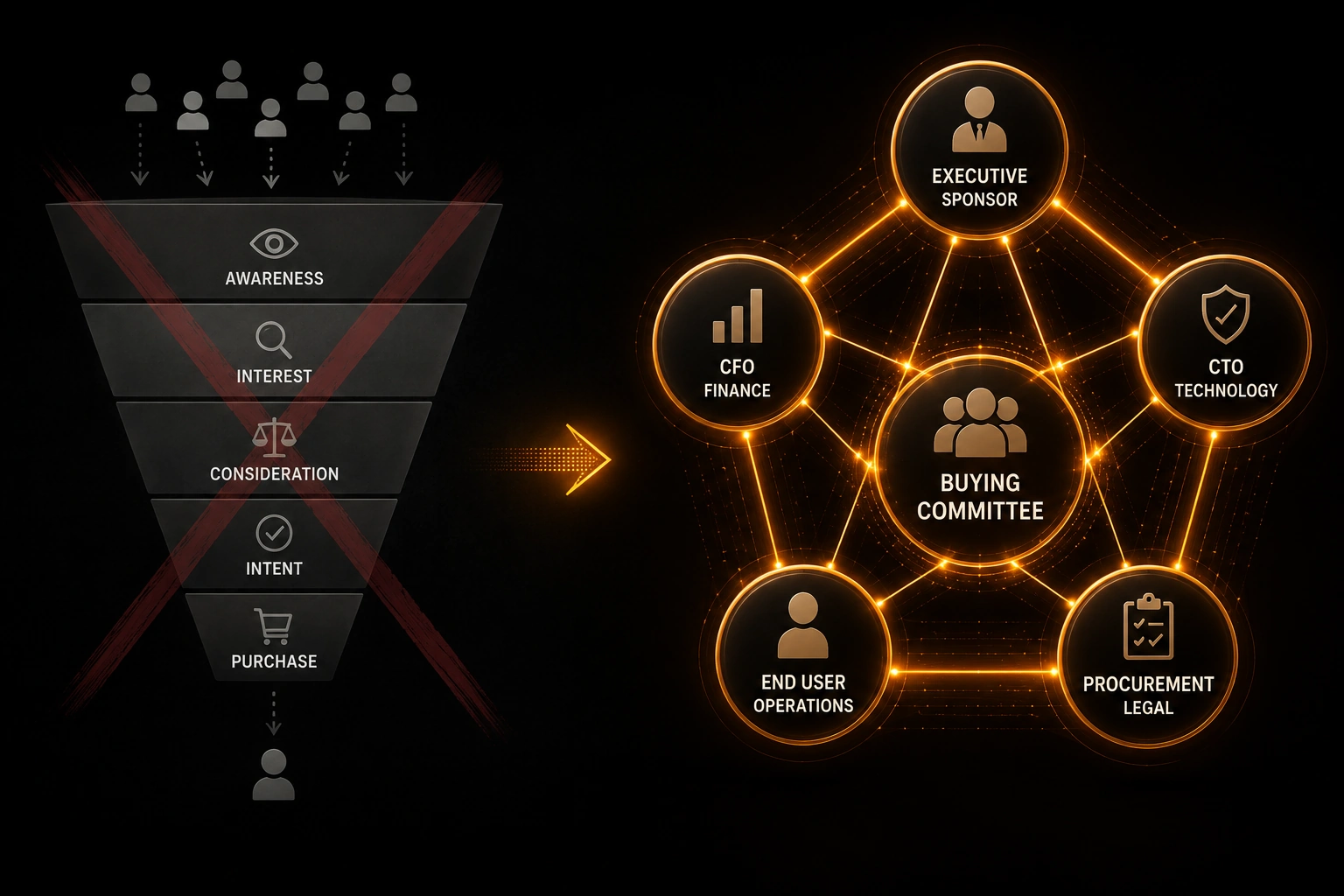
In B2B, buyers don’t talk about “leads.” They talk about projects, missions, and committees. If you are optimizing your marketing to generate a high volume of individual Marketing Qualified Leads (MQLs), you are optimizing for the wrong thing. MQLs do not sign contracts. Committees do.
Are you targeting end-users, or are you targeting the CFO? If you use the same messaging for both, you will fail.
The Shift in Channel: Stop counting individual form fills. Shift your primary lens to Account-Based Marketing (ABM) and buying-party engagement. B2B buying cycles have shortened to roughly 11 months, and buyers are engaging vendors earlier but keeping their shortlists tighter.
The Buyer’s Journey: Traffic must capture two distinct mindsets within the same target account:
Solution Buyers: They care about functionality, integration, and fit.
Reputational Buyers: They care about risk, optics, and defensibility (Can I defend this purchase to my board?).
2. Trust (The Constant: The Inside-Out Engine)

“The 3C Problem: Clarity, Credibility, Conversion”
In B2B, trust cannot be faked with a slick ad. It requires credible voices. And surprisingly, the most credible voices aren’t expensive celebrities—they are your own employees and industry peers.
“You’re not unlucky. You’re unclear.”
If your employees don’t believe your brand, your buyers never will. Internal audiences are no longer just an internal communications consideration—they are a strategic growth lever.
Look at global engineering firm Expleo. Faced with a fragmented workforce of 19,000 employees, they didn’t just send a newsletter. They built a proprietary AI tool allowing employees to generate professional, personalized “superstar” graphics of themselves. It made the brand personal. The result? Over 47% of shares came from employees who hadn’t posted in months, generating 18,000 organic LinkedIn reactions.
B2B Influencer Marketing:
Influence in B2B is shifting toward practitioners and peer networks. When PepsiCo launched Doritos Dinamita exclusively for B2B convenience stores, they didn’t hire a mega-influencer. They targeted the store owners, knowing that 80% of them engage in local community activity. By treating the B2B buyers as the influencers, they generated a retailer-led social movement selling 4,047 packs daily.
3. Transaction (The Commercial Differentiator)

“If you had to change one thing, change this.”
The transaction in B2B is rarely a digital checkout. It is a signed master service agreement (MSA) heavily scrutinized by procurement.
Stop trying to force a “Buy Now” mentality. The conversion event in B2B is a Scheduled Discovery Call, followed by a deeply defended internal business case.
Remove the friction to book that specific event.
“This is where it gets interesting.”
To push the transaction over the line, top B2B brands are leveraging Purpose as a Commercial Differentiator.
Purpose is no longer a “nice to have.” It is a tool for the CFO to justify the spend.
Take NetApp. Data centers consume massive power. Instead of just selling data storage, they launched “The
Campaign to End Single-Use Data.” They borrowed the emotive language of environmentalists to reframe data waste as the equivalent of producing 15 billion plastic bottles. It wasn’t just a tech pitch; it was an ESG (Environmental, Social, and Governance) solution that made the transaction defensible to any board of directors.
“Ignore everything else. Do this.”
Give your buyer a Defensibility Pack: honest AI-inside explainers, scenario walk-throughs, and competitive benchmark data that they can confidently slide across the boardroom table.
When Marketing Thinks Like the Business: Boardroom Influence

“Traffic exposes problems. It doesn’t solve them.”
At some point, every elite B2B marketer realizes that their credibility does not come from brand impressions or pipeline dashboards alone. It comes from fluency in the economics of the company.
As Toby West, Global Head of Marketing at MarketAxess, bluntly puts it:"You’re either a revenue generator or a cost of doing business. In marketing, you very much want to be more the former than the latter."
To win in 2026 and beyond, you must become a Commercial Marketer. This means:
- Tying Metrics to Revenue: Stop reporting on click-through rates. Start shaping your Go-To-Market (GTM) strategy based on Serviceable Addressable Markets (SAM) and anticipated revenue streams. Which client segments deliver the most impact?
- Honesty in Attribution: Do not mask uncertainty with the illusion of precision. Marketing impact is made of tangibles and intangibles. “The reality is that marketing impact is made up of tangibles and intangibles; not everything is linear and fully measurable," West notes. Being clear with your board about what is a direct metric and what is an inferred behavioral shift earns you true executive authority.
When financial acumen is embedded, marketing stops asking for budget and starts allocating capital strategically.
The Road Ahead: 2026 B2B Predictions
Marketing is not a static set of rules to be memorised and applied blindly. As we look toward 2026, the global race is toward trust and value.
AI Foundations Over Hype: AI will run through go-to-market strategies, but enterprises must fix data governance first. 2026 is the year to get your narrative and data ready for AI agents, focus on a handful of end-to-end use cases (scoring, routing) rather than ten disconnected pilots.
Human Expertise is the Sharpest Differentiator: With AI generating endless content, buyers are filtering for what feels human and accountable. Put your product and implementation experts in front of customers earlier.
Agencies as Strategic Infrastructure: The brands that make the most progress will treat their agencies less like campaign suppliers and more like part of their growth infrastructure, demanding business understanding and a unified omnichannel model.
Marketing is not a static set of rules to be memorised and applied blindly. It is a dynamic balance between what remains unchanged—human behaviour—and what is constantly moving—the tactical platforms we use to reach them.
In the upcoming parts of The Moving Constant, we will dive deep into specific sectors to deconstruct exactly how these channels should be configured.
The Bottom Line
B2B marketing is a dynamic balance between emotional, bold creativity and ruthless commercial financial alignment. It is about understanding that a buyer’s digital experience with your brand must flawlessly answer their internal boardroom anxieties.
“Clarity converts. Design supports.”
Build a clear, distinctive narrative. Prove your impact. Orchestrate the entire buying committee. Anticipate the buyer’s career anxiety and answer it with unquestionable, expert-led proof.
Only then do you turn on the traffic.
“Start here.”
Is your B2B marketing strategy aligned with your boardroom’s revenue goals?
We provide comprehensive, human-reviewed strategic audits. A senior growth strategist from our team will evaluate your account-based marketing, content hierarchy, CRM integration, and commercial metrics to identify gaps where your strategy might be misaligned with your buying group.
→ Request a Strategic Audit

Comments