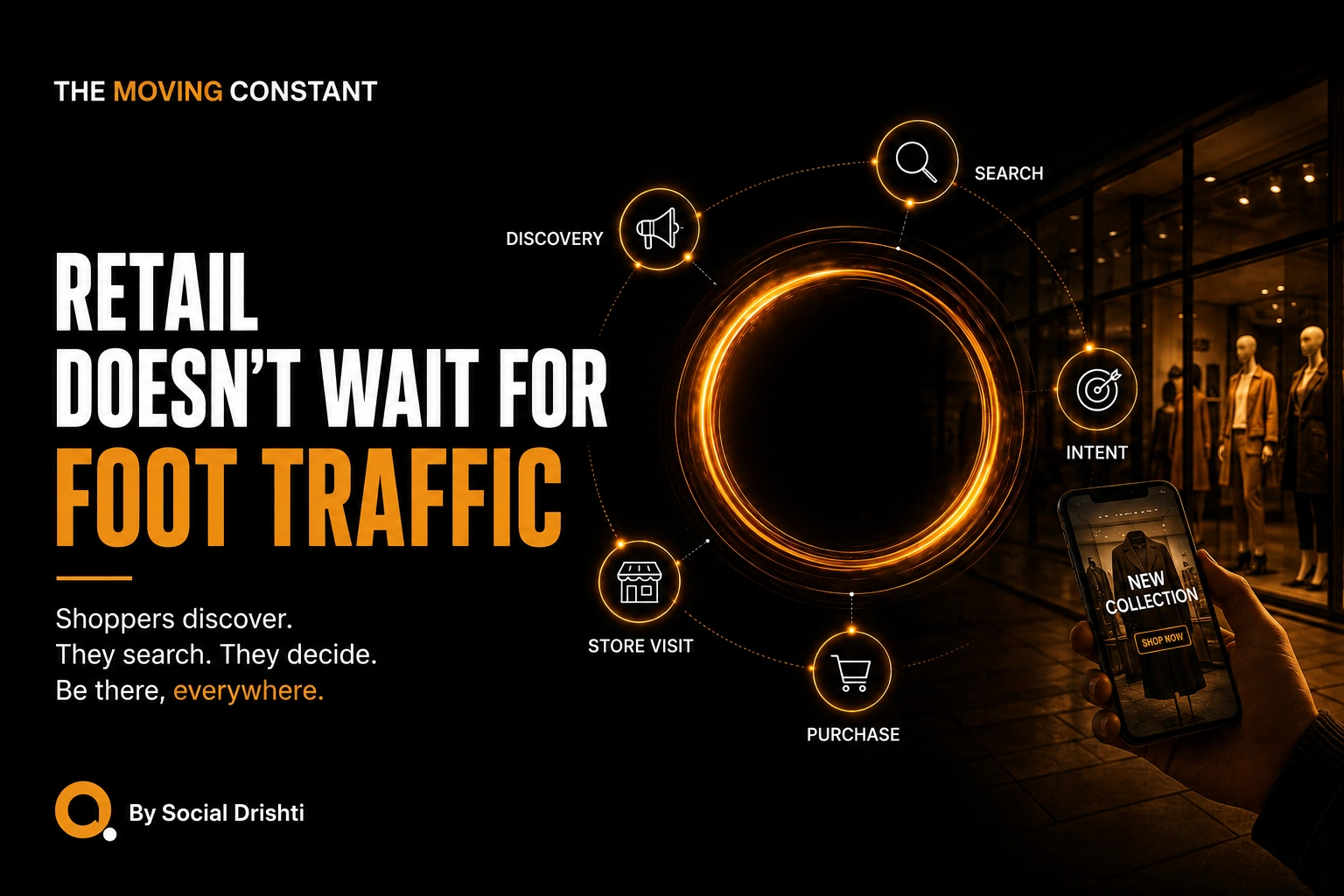
Most retail business owners believe that foot traffic is strictly dictated by their store’s physical location and the size of their display window.
They are wrong.
Prime real estate no longer guarantees sales. In a world where global competitors are just a screen tap away, your most important storefront isn’t on a busy street—it’s on a smartphone. Advertisers are now spending more money on mobile advertising than on all traditional channels combined.
If your customers spend hours every day scrolling on their phones, why are you still hoping they just happen to walk past your window?
A regional retail chain came to us after spending ₹10L on newspaper spreads and billboard ads.
Zero measurable foot traffic.
The problem wasn’t their products. It was their complete lack of attribution.
This is where most businesses lose money.
They spend massive budgets on generic reach but fail to optimize for intent. Traffic exposes problems. It doesn’t solve them. To win in retail today, you need a balanced, platform-specific strategy that connects the digital click to the physical cash register.
Here is the ultimate, platform-by-platform marketing playbook for retailers.
The Google Playbook (Search & Discovery)
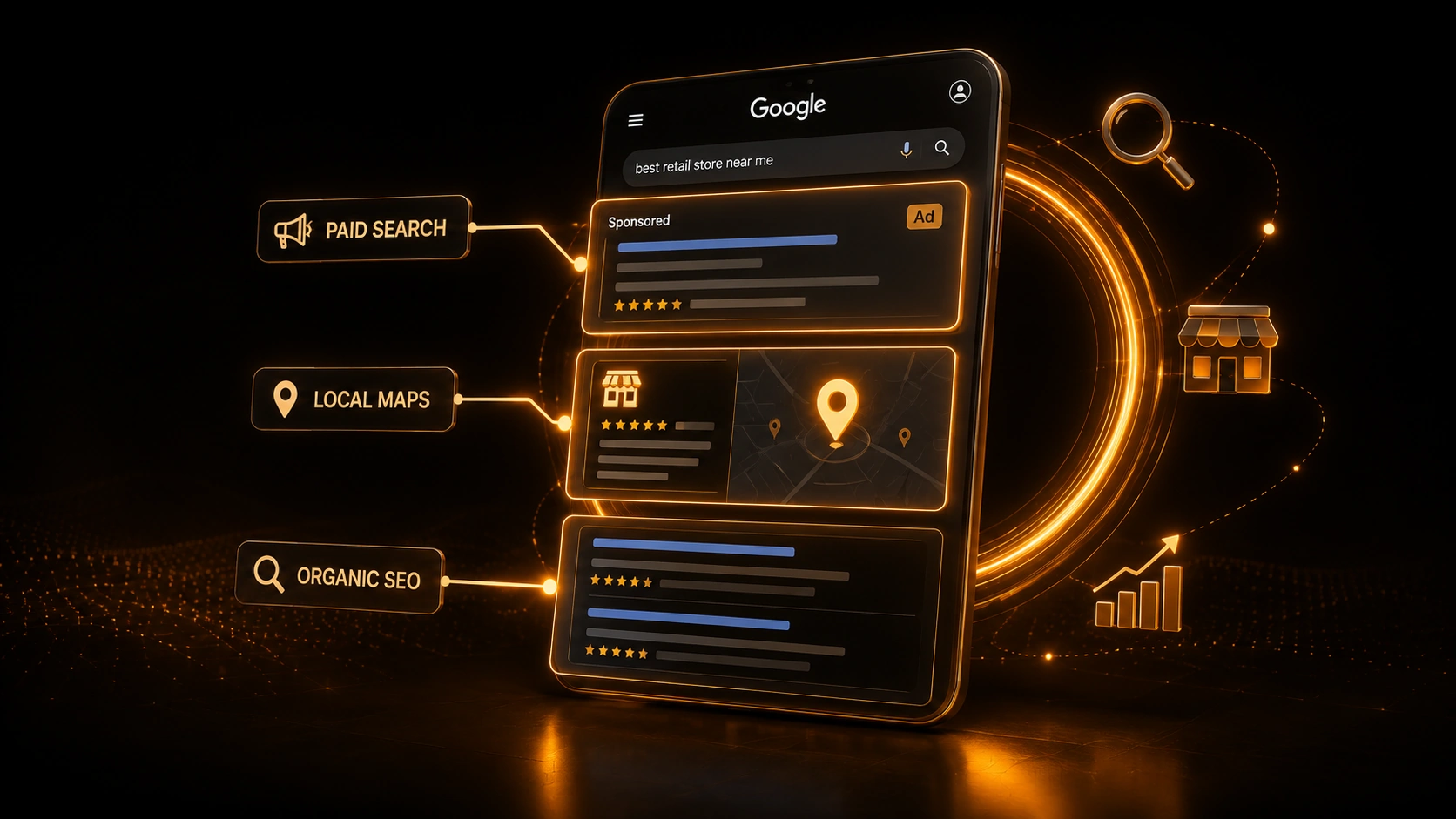
The search engine results page (SERP) is the most valuable virtual real estate a marketer can own. Google accounts for over 30% of global digital advertising. But here is the harsh truth: your well-optimized website is being pushed below the fold by ads and localized results.
Start here.
To command the SERP, retailers must execute a stacked strategy:
- Google My Business (GMB): This is non-negotiable for offline retail. Optimize your GMB to appear front and center in local map packs.
- Pay-Per-Click (PPC/SEM): Use Google Ads to bid on high-intent search queries. This is how brands like Future
- Group use search effectively to increase convenience for their buyers in real-time.
- Organic SEO: Adhere to best practices on a product-page level with strong inbound links and content creation to maintain long-term authority.
When a brand has multiple results on page one (Ads + GMB + SEO), not only does the chance of a click skyrocket, but brand perception dramatically increases.
The Meta Playbook (Facebook & Instagram)
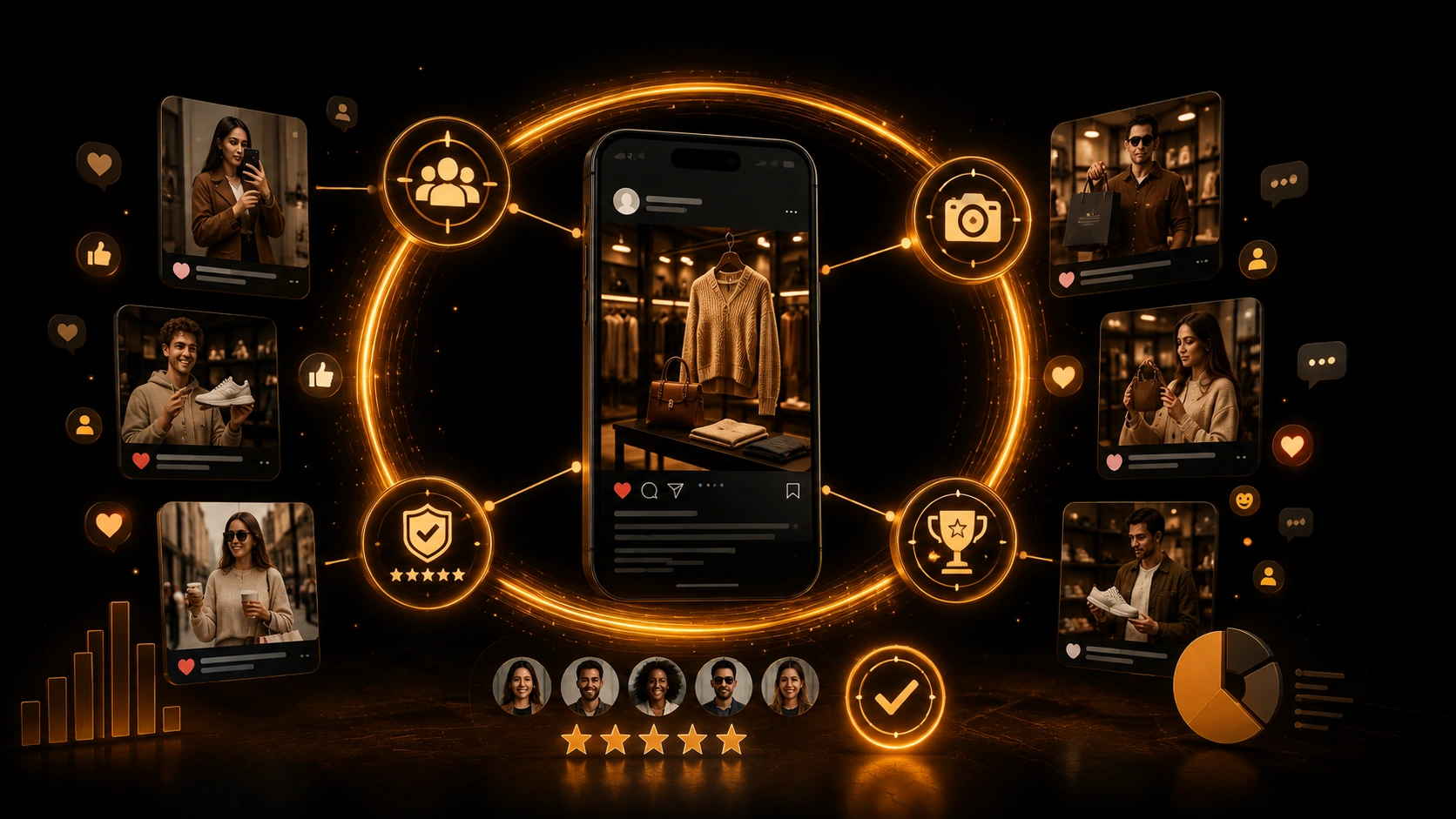
Carpet bombing your audience with generic display banners doesn’t work anymore. You need to leverage social data to build targeted preference.
This is where it gets interesting.
Mini Framework: The UGC Trust Loop
Targeted Reach → User Generated Content (UGC) → Gamification → Social Proof
- Facebook for Localization & Engagement: Predominantly offline retailers (like Toons Retail) use Facebook to ensure consumers can easily locate physical stores. It is also the ultimate platform for gamification. Running region-specific contests is a massive hook to engage consumers and build local hype.
- Instagram for Influencers & Rebranding: Influencer marketing is the natural extension of word-of-mouth. Crocs. India used Instagram-led UGC (User Generated Content) campaigns to completely break the stereotype that they only sold clogs. By partnering with influencers, they showcased a trendy new range, changing how the brand was perceived and driving acceptance for their complete product line.
- Content Curating: Do what Pepe Jeans does—create style guides across social platforms showing visitors how to incorporate items into their everyday lives.
The Retention Playbook (Email & Affiliates)
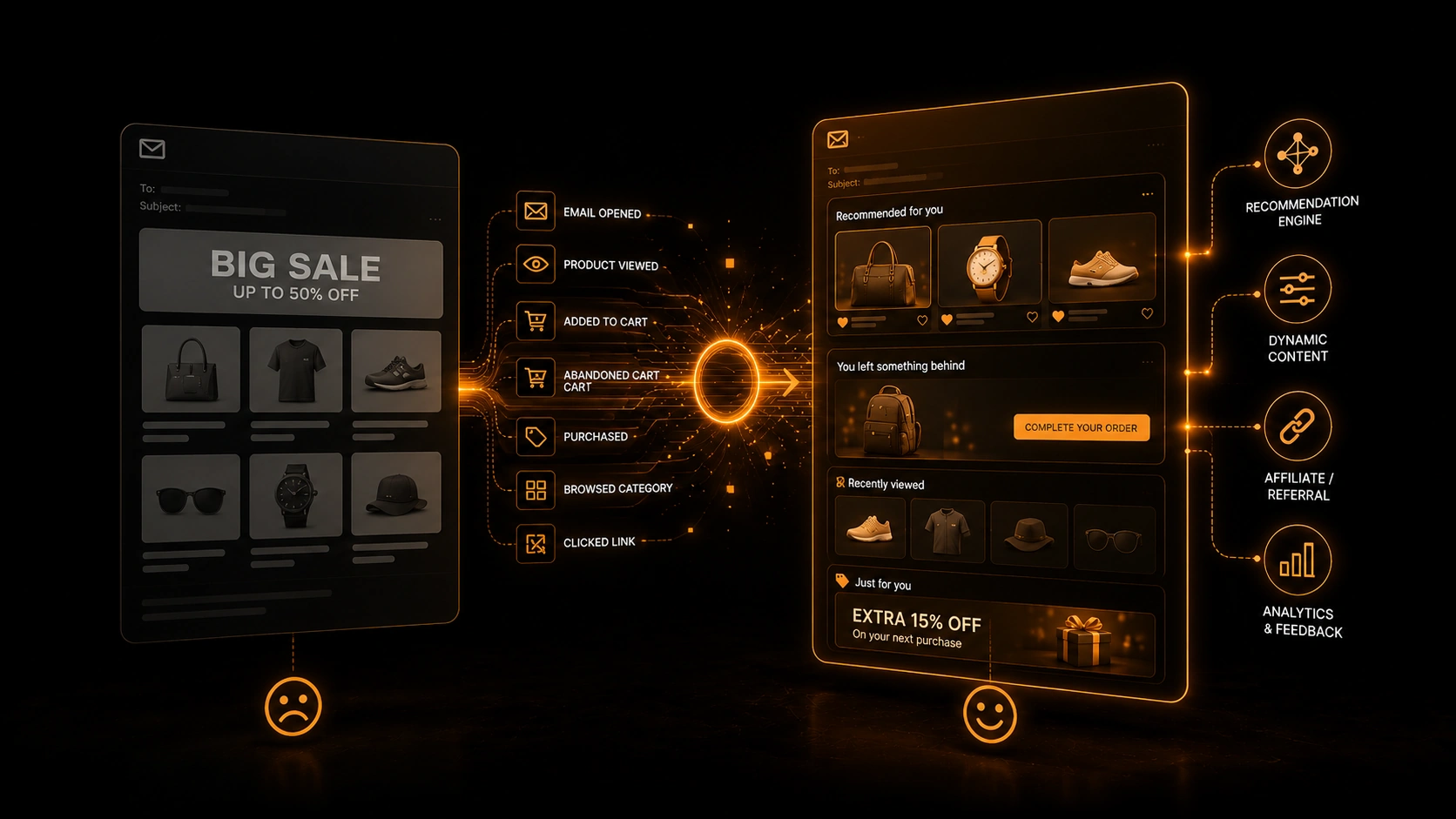
If you think email is dead, you are doing it wrong.
If you had to change one thing, change this.
Stop treating email like a one-way megaphone.
As Varun Arora from Orra Fine Jewellery notes, email marketing has shed its “fuddy-duddy” static imagery. Today, it must be an interactive tool.
- Dynamic Email Marketing: Use abandoned cart notifications and remarketing. Base your next line of communication strictly on how the consumer responded to the previous email. Use in-depth pre- and post-sharing analysis to predict their next purchase.
- Affiliate Marketing: Build credibility through third-party product-focused content. Use reviews, comparisons, and testimonials from trusted industry websites to drive referral traffic.
The 3C Problem: Clarity, Credibility, Conversion.
Affiliates build the credibility. Email drives the conversion.
The Content Playbook (Blogs & Analytics)
Shareable content is the benchmark of success in retail content marketing. You must deliver value before asking for a sale.
- Educational Content: Reliance Vision Express successfully uses blogs to educate prospective customers about the latest trends in eyewear technology. Educate first, sell second.
- Data Analytics & Social Listening: With millions of consumers online, data analytics is critical. Track conversations around your retail brand to understand perception and feedback, much like Inorbit Malls does to predict consumer behavior.
Clarity converts. Design supports.
The Attribution Playbook (Online-to-Offline)
For years, connecting a digital ad to a physical store visit was a marketer’s pipedream. Today, advanced digital marketing analytics realizes this with a high level of accuracy.
You’re not unlucky. You’re unclear.
If you are only optimizing for online engagement, you are missing the bigger picture. You can tweak campaigns to increase click-through rates, but clicks don’t pay the bills. Optimizing only for clicks might actually exclude a massive chunk of your audience who won’t click, but will physically visit your store.
How to track digital-to-physical ROI:
- Google Store Visits: Google tracks phone location history across devices to estimate if a user who interacted with your search ad actually walked into your store.
- Facebook O2O (Online-to-Offline): Provides insight into users who were exposed to your advertising (even if they didn’t click) and later visited your offline location.
- Dynamic Couponing: Issue specific coupon codes tied to different digital platforms (e.g., one code for Instagram, one for Google). Track redemptions at the physical checkout to calculate the exact Return on Ad Spend (ROAS) of each channel.
The Creative Multiplier

The channel mix is set. The O2O tracking is live. Now, what are you actually saying?
A recent study by Nielsen analyzed 500 campaigns and found that 47% of a brand’s sales lift from advertising was a direct result of the creative.
Ignore everything else. Do this: Don’t let your creative strategy be an afterthought.
Utilize dynamic ads on Google and Facebook. Feed the platforms multiple headlines, images, and offers. Let their systems dynamically rotate and test these assets based on real-time user behavior, matching the perfect message to the perfect person.
The Road Ahead
Marketing is not a static set of rules to be memorised and applied blindly. It is a dynamic balance between what remains unchanged human behaviour and what is constantly moving the tactical platforms we use to reach them.
Comments