Most marketing agencies sell an illusion.
They call it a “proven blueprint,” a “universal playbook,” or a “proprietary system”. But when the campaign goes live, the reality sets in. The metrics do not align, the leads do not close, and the budget disappears.
Why does a strategy that generated millions for one business produce silence for another?
Because in marketing, context dictates survival. If the same template worked for everyone, execution would be a simple setting on an ad dashboard. The truth is much more complex.
“This is where most businesses lose money.”
The Illusion of the Best Practice
When you look at successful brands, it is easy to copy their external actions. You see a competitor posting daily reels, hosting a podcast, or running high-production video ads. You assume that because they are doing it, you should too.
But you are only seeing the surface. You do not see their unit economics, their customer lifetime value (LTV), or their retention rates.
When you copy the tactics of a business with a completely different model, you create a structural mismatch.
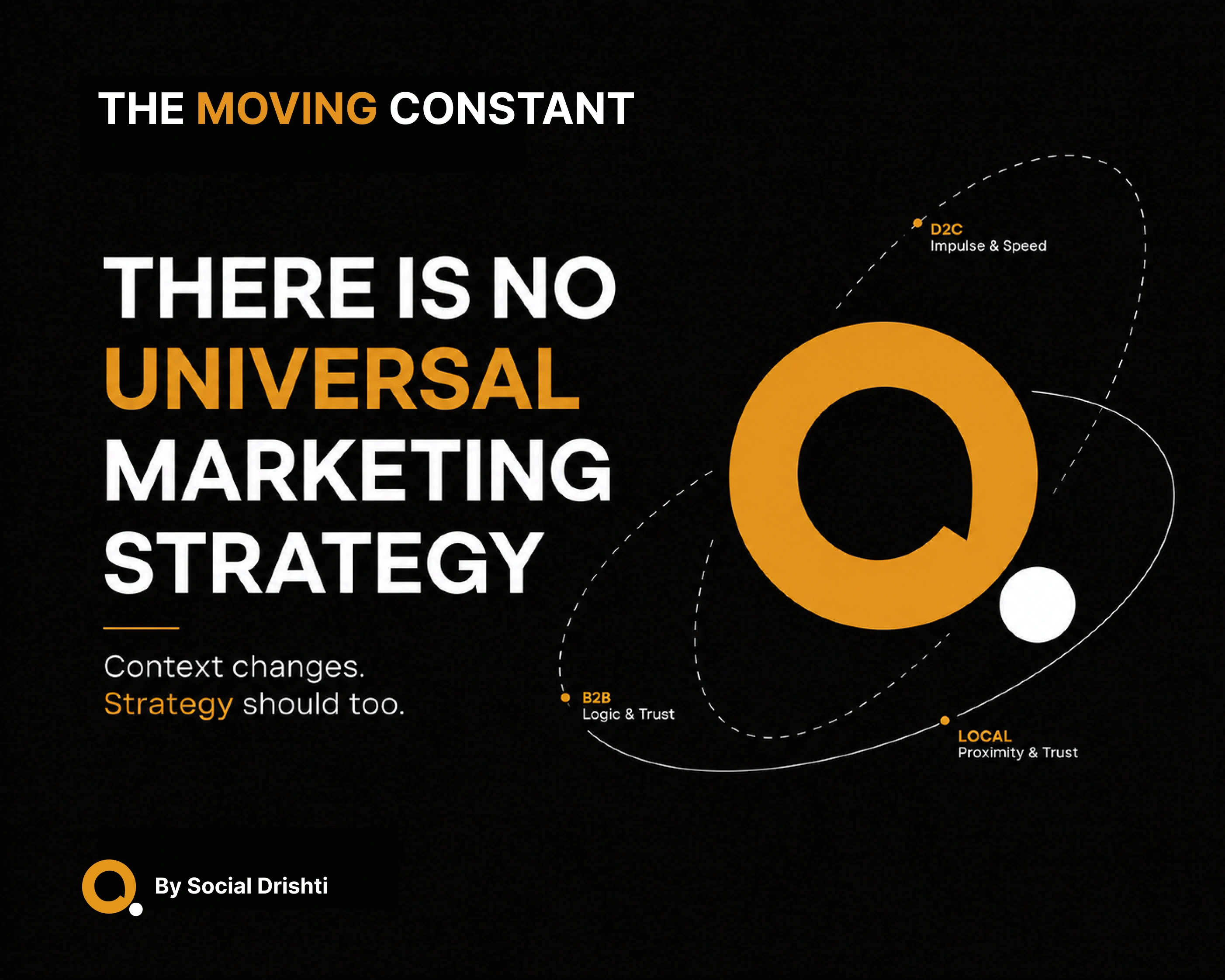
- The D2C Playbook relies on impulse, visual desirability, and low-friction checkout.
- The B2B Playbook relies on risk mitigation, logical justification, and relationship building.
- The Local Service Playbook relies on geographical convenience, personal trust, and immediate search visibility.
Trying to run a B2B SaaS company using D2C tactics is like trying to navigate a ship with a road map. The tool itself isn’t broken; it is simply designed for a different landscape.
The Strategic Realignment
To build an engine that actually converts, you have to look past the surface level.
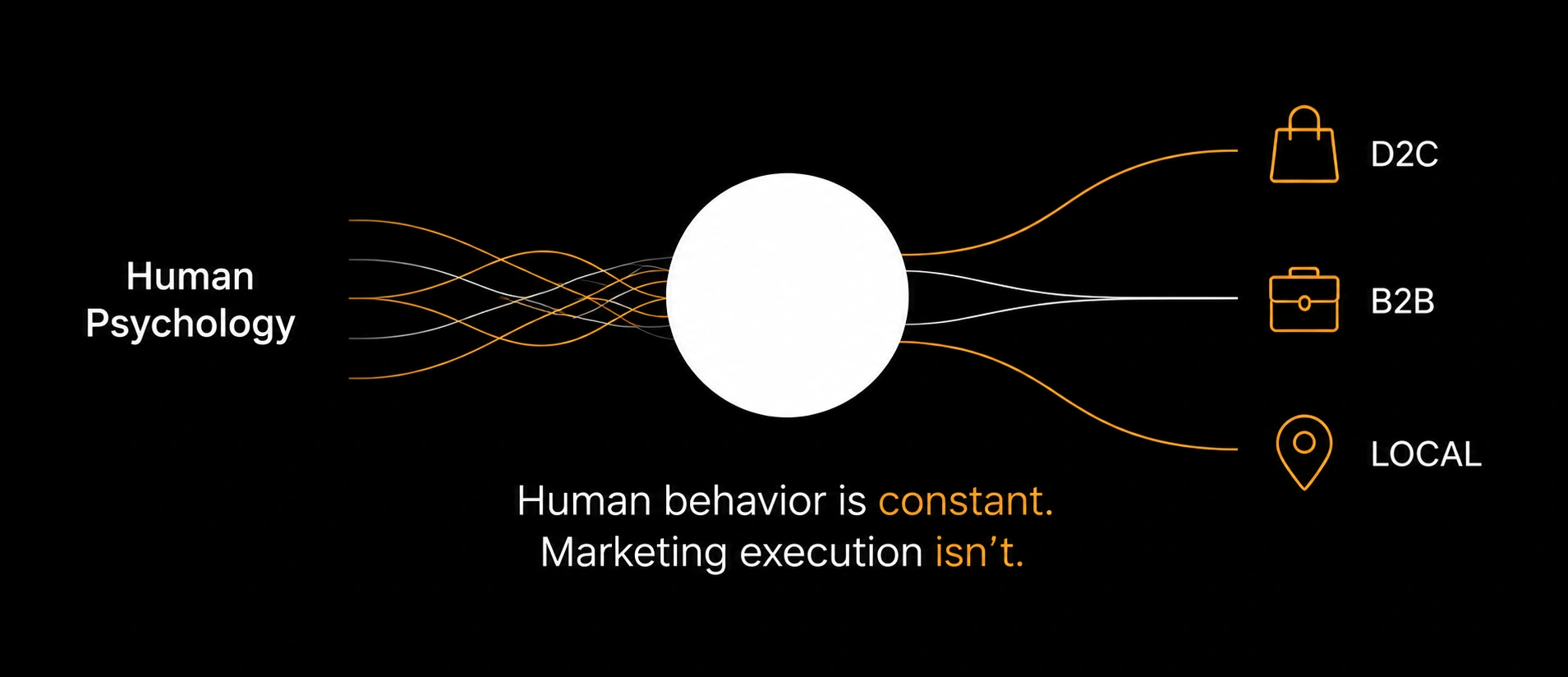
Every successful marketing system relies on core human elements: attention, trust, and transaction. These fundamentals do not change. No matter the year, the platform, or the technology, humans still buy from entities they trust to solve their problems.
But how that trust is built, where that attention is captured, and how that transaction occurs is constantly in flux.
This paradox lies at the heart of sustainable growth: the psychological principles of persuasion remain fixed, while the tactical executions must evolve daily to match the market.
This is the moving constant.
Welcome to The Moving Constant by Social Drishti, a series dedicated to deconstructing the core strategic differences across industries. Over the next few weeks, we will explore why standard marketing advice fails when applied to specific sectors, and how to build a custom system that respects your business’s unique buying journey.
“Start here.”
How Different Industries Interact with Marketing Channels
To understand why a universal strategy is impossible, we must look at how different business models utilise the exact same marketing channels. The tool remains constant; the application moves.
1. Social Media & Content
Local Services: Social media is a window into the community. It is about showing real people, real transformations, and the environment. High-production, abstract brand videos fail here; raw, authentic community proof wins.
B2B: Social media is a platform for thought leadership. It is where your leadership team demonstrates domain expertise. It is not about entertainment; it is about proving you understand the prospect’s operational pain points.
D2C: Social media is an interactive catalog. It relies on short-form video, aesthetic appeal, and immediate creator validation.
2. Online Reputation Management (ORM)
Gyms / Local Services: ORM is a primary conversion driver. A local customer searches “best gym near me” and decides entirely based on recent Google Reviews and star ratings.
B2B: ORM happens behind closed doors, on platforms like G2, or through backchannel LinkedIn references. It requires structured case studies and formal reference calls.
D2C: ORM is built directly into the product page. Star ratings, user-submitted photos, and community Q&As must exist at the exact point of purchase to counter buying hesitation.
3. Website & Digital Experience
Gyms / Local Services: The website has one job: reduce friction to visit. It needs clear location details, operating hours, and a simple “Book a Free Session” button.
B2B: The website is an educational resource. It must handle complex buyers, procurement requirements, and security concerns. It often features deep-dive whitepapers, integration documentation, and custom demo bookings.
D2C: The website is a transactional engine. Speed, checkout simplicity, and payment flexibility are critical. If your mobile page speed is slow, or if you force unnecessary account creation, you will find your ads get clicks but no sales because the buying path collapsed.
A Case of Brand Misalignment
A high-end architectural firm specialising in luxury residential projects came to us after a disappointing six-month campaign with a traditional creative agency.
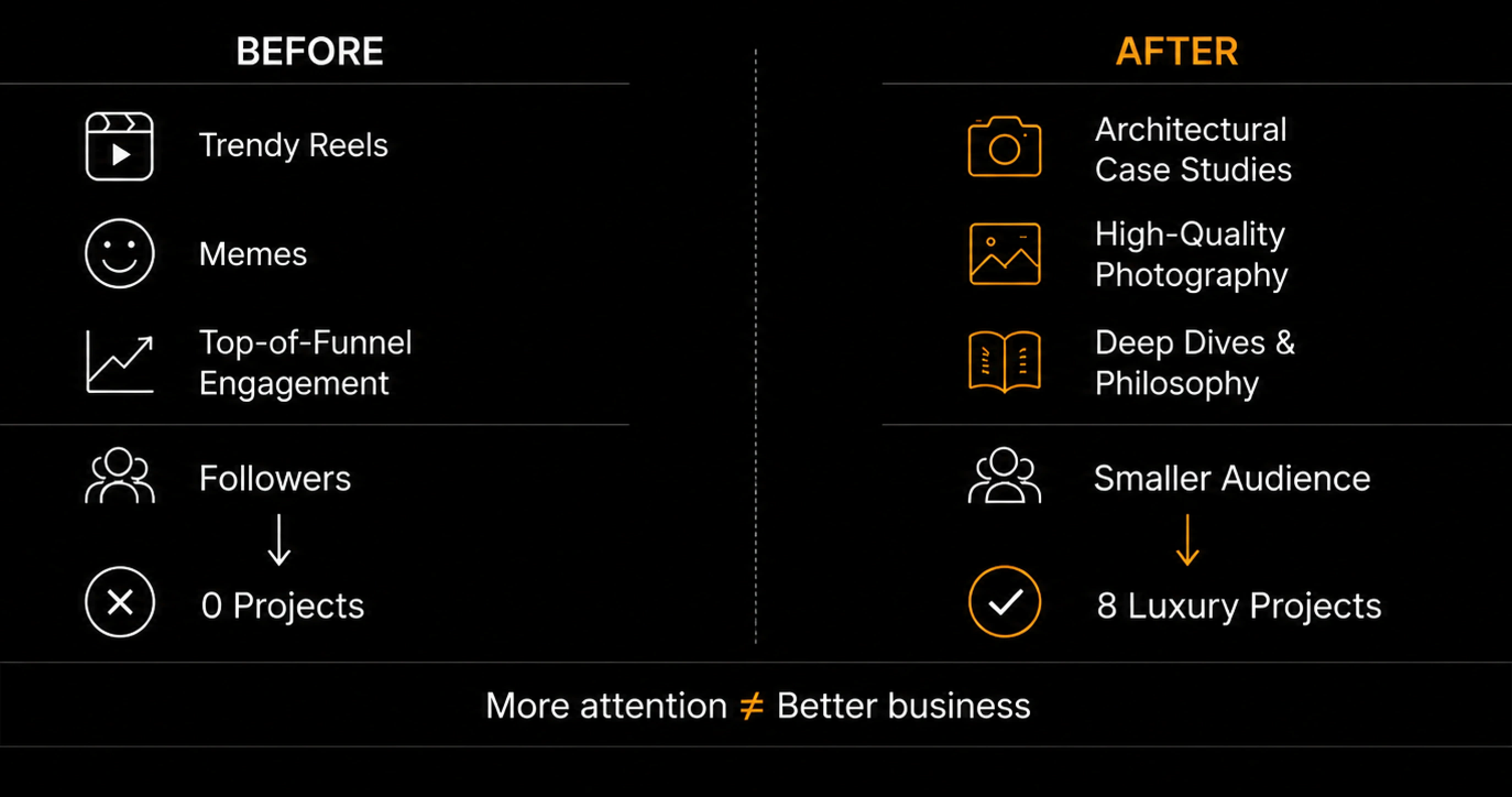
The agency had applied a standard “viral growth” playbook. They focused heavily on trendy Instagram Reels, daily interactive stories, and humorous meme-marketing to build “top-of-funnel engagement.”
On paper, the brand’s social metrics grew. They gained thousands of followers, and their videos received high engagement.
The business results? Zero actual design consultations booked.
The problem was a fundamental misalignment of the channel and the audience. Luxury home builders do not select an architect because of a funny video. They choose an architect based on prestige, historic portfolio quality, and professional discretion.
We restructured their approach completely:
The Shift in Content: We replaced the trend-focused reels with architectural case studies, high-resolution photography, and deep dives into the spatial philosophy behind their builds.
The Shift in Channel: We shifted budget away from broad social targeting and focused on high-end PR placements, regional design publications, and search engine optimisation (SEO) targeting high-intent local search queries like “luxury modern architects [City].”
The Result: Within four months, their total audience size grew at a much slower rate, but they secured eight qualified, high-ticket villa design projects.
They did not need more traffic. They needed the right kind of trust.
Comparing the Execution Profiles
Industry Type | Primary Traffic Driver | Trust Builder | Conversion Event |
|---|---|---|---|
D2C / E-commerce | Meta/Google Shopping Ads | Social Proof & User Reviews | Seamless Online Checkout |
B2B Services | LinkedIn Content & Search SEO | Case Studies & Industry Whitepapers | Scheduled Discovery Call |
Local Gyms / Studios | Local SEO & Geo-Targeted Ads | Google Reviews & Free Trial Session | In-Person Facility Tour |
Real Estate | High-Quality Video Shoots & Search | Developer Pedigree & Site Visits | Private Consultation Booking |
How to Audit Your Strategic Fit
Before launching your next marketing campaign, ask yourself three diagnostic questions to ensure you are not running a mismatched playbook:
- What is the real cost of a mistake for my buyer? If the cost is low (e.g., buying a ₹1,000 t-shirt), optimise for impulse and speed. If the cost of a mistake is high (e.g., hiring a B2B software vendor or choosing a home), optimise for deep education and risk mitigation.
- Where does my audience look when they have a problem? Do they browse social media passively (D2C), search intent-driven terms on Google (Local/B2B), or ask their professional network for recommendations (B2B)?
- Does my checkout match my buyer’s speed? A local gym member wants to book a session in two taps. A corporate buyer expects a custom proposal and security validation. Do not force a corporate process on a local buyer, or a self-serve checkout on a complex client.
The Road Ahead
Marketing is not a static set of rules to be memorised and applied blindly. It is a dynamic balance between what remains unchanged—human behaviour—and what is constantly moving—the tactical platforms we use to reach them.
In the upcoming parts of The Moving Constant, we will dive deep into specific sectors to deconstruct exactly how these channels should be configured.
- Part 2: Gyms Don’t Sell Memberships
- Part 3: Real Estate Doesn’t Sell Property
- Part 4: B2B Doesn’t Buy Products
Is your marketing strategy aligned with your business model?
We provide comprehensive, human-reviewed strategic audits. A senior growth strategist from our team will evaluate your current channels, website structure, and performance metrics to identify gaps where your strategy might be misaligned with your target audience.
→ Request a Strategic Audit
Comments