Let’s begin with an expensive truth that ad agencies and platforms work very hard to keep you from noticing.
A click is not a purchase.
A click is merely a transactional transaction of attention—someone gave you three seconds of their time because an ad caught their eye. But a sale requires something entirely different: trust, alignment, and a seamless checkout experience.
When businesses come to us after spending ₹50K, ₹1L, or more on Meta or Google Ads, they are often incredibly frustrated. Their dashboards look healthy on paper. They see rising click-through rates (CTR), falling cost-per-click (CPC), and hundreds of daily visitors.
Yet, their sales dashboard remains empty.
At this point, the default reaction is to panic-edit. They change the ad creative, swap out the headline, or test a new audience.
But if people are already clicking, your ad has already succeeded. The leak isn’t inside your ad account. It’s what happens after the click.
“The ad did its job by winning the attention. If that attention does not turn into revenue, you do not have an ad problem. You have a conversion system problem.”
The Saturation Trap: Why Cheap Clicks Are Often Empty
Before rebuilding your campaigns, you need to understand the structural difference between traffic and intent.
Not all clicks are created equal. When ad networks became highly optimized to lower the cost of a click, they did so by finding the users most likely to tap on their screens.
The industry refers to this as the “Curiosity Click”.
There is a massive cohort of internet users who click on almost everything they see but have a historical conversion rate of near-zero. If your campaigns are structured incorrectly, the algorithm will deliver exactly what you asked for: millions of cheap clicks from users who will never open their wallets.
Here are the four primary places where the buying path breaks between the ad and the checkout.
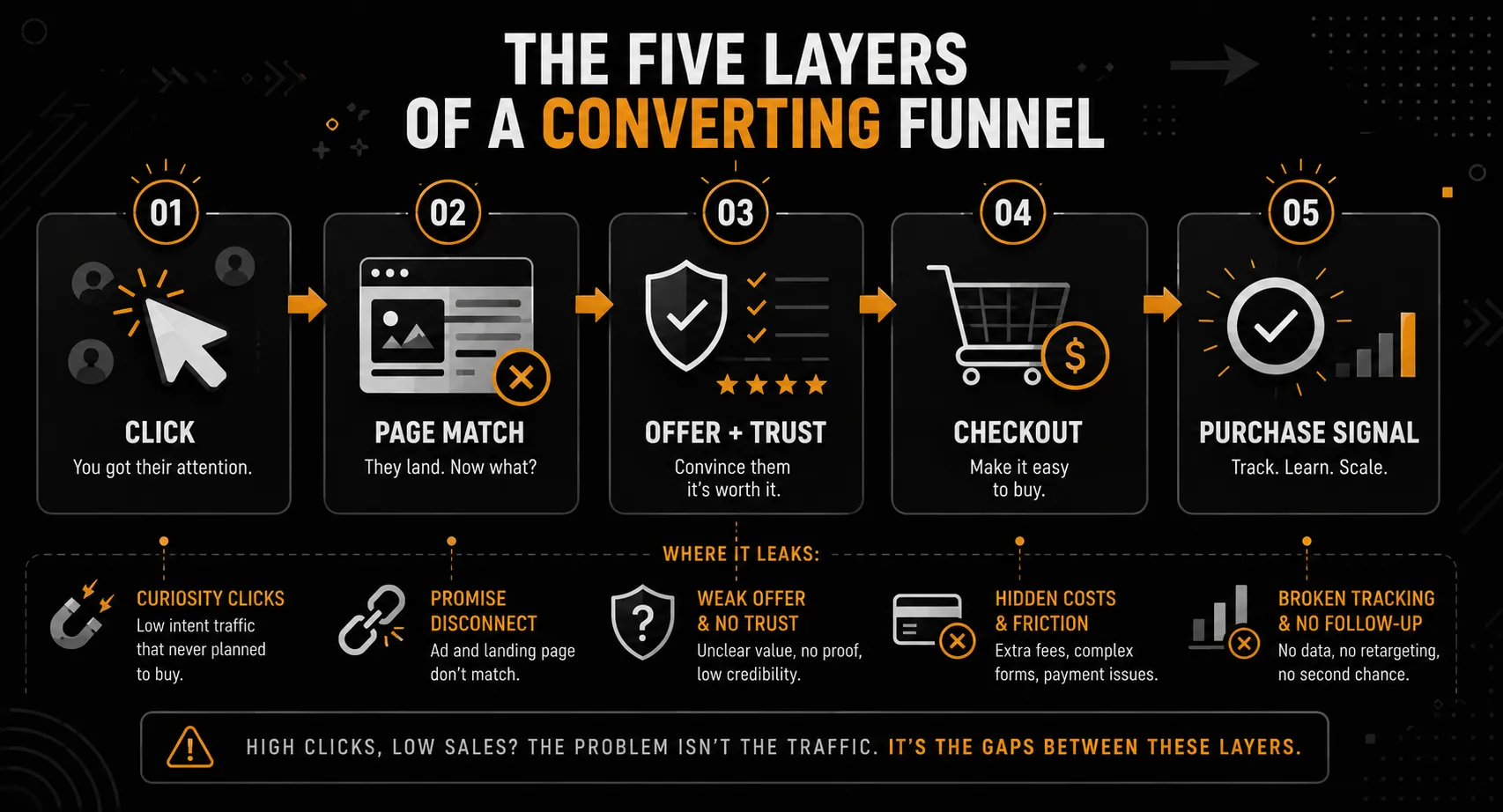
1. The Ad-to-Page Disconnect (The Broken Promise)
When a user clicks your ad, they do so with a highly specific expectation in mind. They clicked because they saw a specific product, a distinct deal, or a clear promise.
If they land on your website and that specific promise isn’t instantly visible, they leave.
This mismatch is the single largest cause of wasted ad spend. If you are running an ad for a specific product, the landing page must feature only that product. If your ad highlights a discount code, that discount code must be automatically applied or clearly displayed above the fold on the destination page.
Any pause the user has to make to “find” what they clicked on is a point where the sale is lost.
2. The Algorithmic Mismatch (Optimizing for the Wrong Action)
If you run Meta or Google campaigns, the algorithm is literal. It will do exactly what you pay it to do.
If you select “Traffic” or “Link Clicks” as your campaign objective: The algorithm will search its user base for the cheapest clickers. It ignores purchase history and intent, optimizing solely for volume.
If you select “Conversions” or “Purchases” as your campaign objective: The system will skip the casual clickers and bid specifically for users with a clear track record of buying online, even if those clicks cost slightly more.
If you are optimizing for traffic because you want “brand awareness” first, you are actively training the ad platform to feed you users who bounce.
3. Checkout Friction and Hidden Costs
If your metrics show that users are clicking your ads, viewing your product pages, and even adding items to their cart—but dropping off before the payment is made—you have a friction problem.The average modern shopper has zero patience for a complex checkout path. The conversion breaks when you ask them to:
Create an account before they can see the final total.
Fill out an unnecessarily long, ten-field form.
Pay high, hidden shipping or delivery fees that only appear at the final stage of payment.
[ Product Page: ₹1,499 ] ──> [ Add to Cart ] ──> [ Checkout: + ₹150 Shipping + GST ] ──> [ Abandoned Cart ]
When a user sees a price jump unexpectedly at checkout, they feel deceived. Transparency is your strongest conversion tool.
4. The Blind Spot: Broken Conversion Tracking
Sometimes, you actually are making sales, but your ad platform has no idea.
If your conversion tracking (Meta Pixel, Google Tag Manager, or GA4) is broken, misconfigured, or missing entirely, the ad platform cannot track what happens after the click.
Without this feedback loop, the algorithm is operating blind. It cannot learn which search terms, creatives, or demographics turned into real paying customers, so it continues to distribute your budget across low-converting, high-click audiences.
A Real Story: The ₹1.2L E-commerce Campaign That Produced Crickets
A boutique D2C home-decor brand in India came to us after launching their launch campaign.
They had spent ₹1.2L on Instagram ads over five weeks. On paper, their agency reported stellar numbers: over 8,000 clicks, an average CTR of 2.1%, and a highly efficient CPC of just ₹15.
The client’s actual revenue? Exactly four purchases.
They were convinced that their products were too niche for social media or that their pricing was off.
We ran a strategic audit on their buying path and found three distinct leaks:
Objective Mismatch: The agency had set up the campaigns under the “Traffic” objective to “build a pixel signal first.” They were buying thousands of casual clicks from users who had no intention of shopping.
The Promise Gap: The ads featured beautiful lifestyle shots of custom cushions, but clicking the ad dropped users directly onto a slow-loading, generic category page for all living room accessories.
Friction-Heavy Checkout: The website forced users to register, verify their email address via OTP, and fill out a complex delivery form before showing the final price.
Before: [ Traffic Ads ] ──> [ Slow Category Page ] ──> [ Forced OTP Signup ] ──> 4 Sales
After: [ Purchase Ads ] ──> [ Specific Product Page ] ──> [ 1-Page Guest Checkout ] ──> 94 Sales
We completely restructured the campaign. We changed the objective to “Purchases”, redirected the traffic directly to specific product pages matching the ad creatives, enabled guest checkout, and streamlined the payment process into a single page.
The CPC rose to ₹35 because we were bidding for higher-intent buyers, but their monthly sales jumped to 94 purchases within the same budget.
Instead of This | Try This Instead
Instead Of Copying This | Try This Instead |
|---|---|
Optimizing campaigns for “Traffic” or "Clicks" | Optimizing for “Purchases” or “Leads” from day one |
Sending ad traffic to your generic homepage | Creating dedicated, fast-loading, single-product landing pages
|
Hiding shipping fees and taxes until the end | Offering transparent, upfront pricing or free shipping options |
Forcing account creation at checkout | Enabling single-click guest checkouts |
The Strategic Audit: Stop the Leak in 4 Steps
Before you spend another rupee on paid ads, check these four fundamental conversion metrics:
- Check Your Campaign Objective: Are your Meta or Google Ads set to “Traffic,” “Maximise Clicks,” or “Conversions”? If it’s not optimized for conversion outcomes, change it.
- Confirm Your Tracking Setup: Use tools like Google Tag Assistant or Meta Pixel Helper to confirm your “Purchase” and “Add to Cart” tags are firing correctly.
- Run a Mobile Speed Test: Test your landing page on Google PageSpeed Insights. If it’s slow on mobile, compress your images and clean your site’s codebase.
- Audit Your Checkout Path: Open your phone, click your own ad, and attempt to buy your product. If the process feels long, repetitive, or surprises you with hidden fees, simplify it immediately.
This Is Part of a Bigger Series
This blog is part of our five-part series addressing the core systemic failures in modern business marketing and how to fix them.
- Why your brand is losing leads in 5 seconds?
- Why your website gets traffic but no leads?
- Why your reels stop at 300 views?
- Why your ads get clicks but no sales (You are here)
Think your ad campaigns are leaking budget?
We do free, human-reviewed marketing audits. A real strategist from our team will audit your landing pages, checkout flows, and ad setup to tell you exactly why your clicks aren’t turning into sales before you spend another rupee on traffic.
Comments