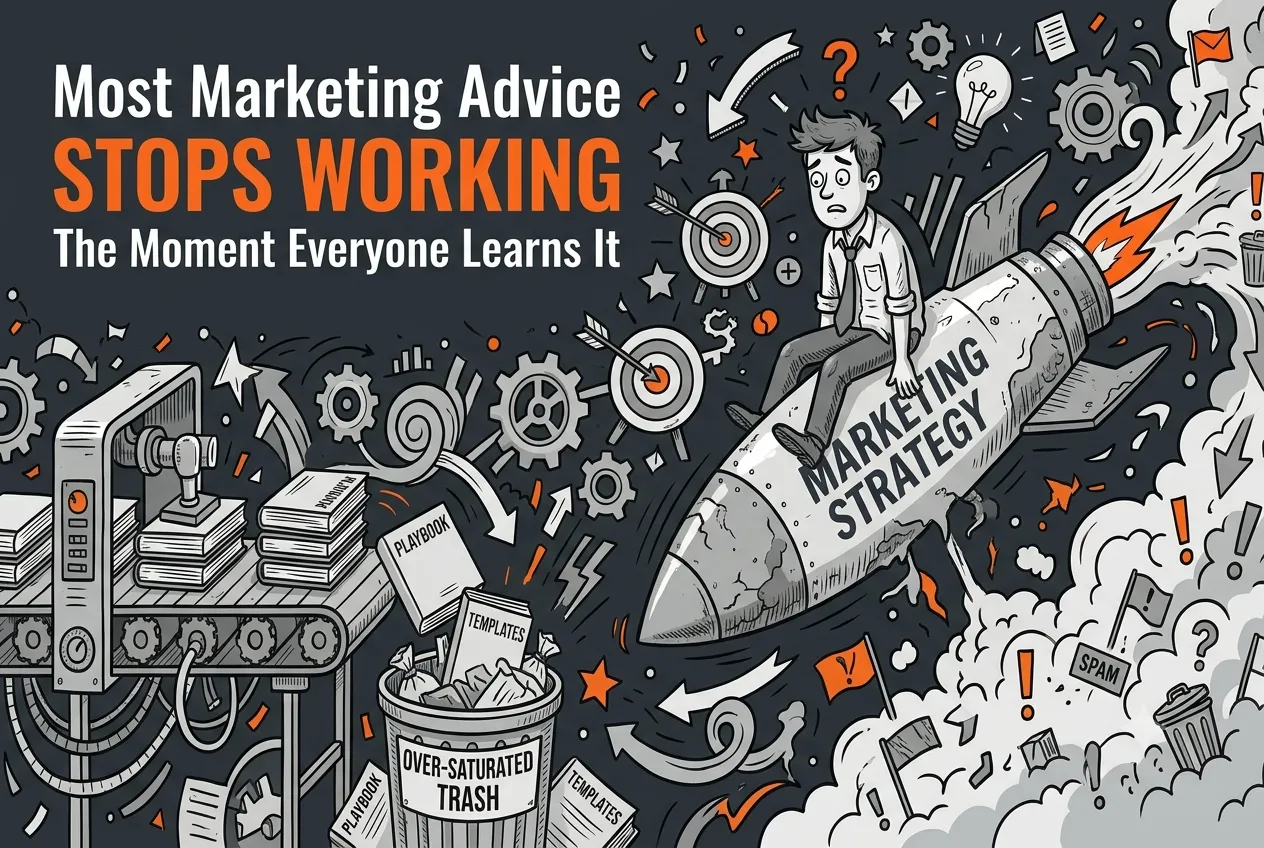
Let’s begin with an uncomfortable truth that the marketing industry tries very hard to ignore.
The moment a marketing “growth hack” is published in a viral thread, packaged into a course, or automated by a software tool, its effectiveness begins to decay.
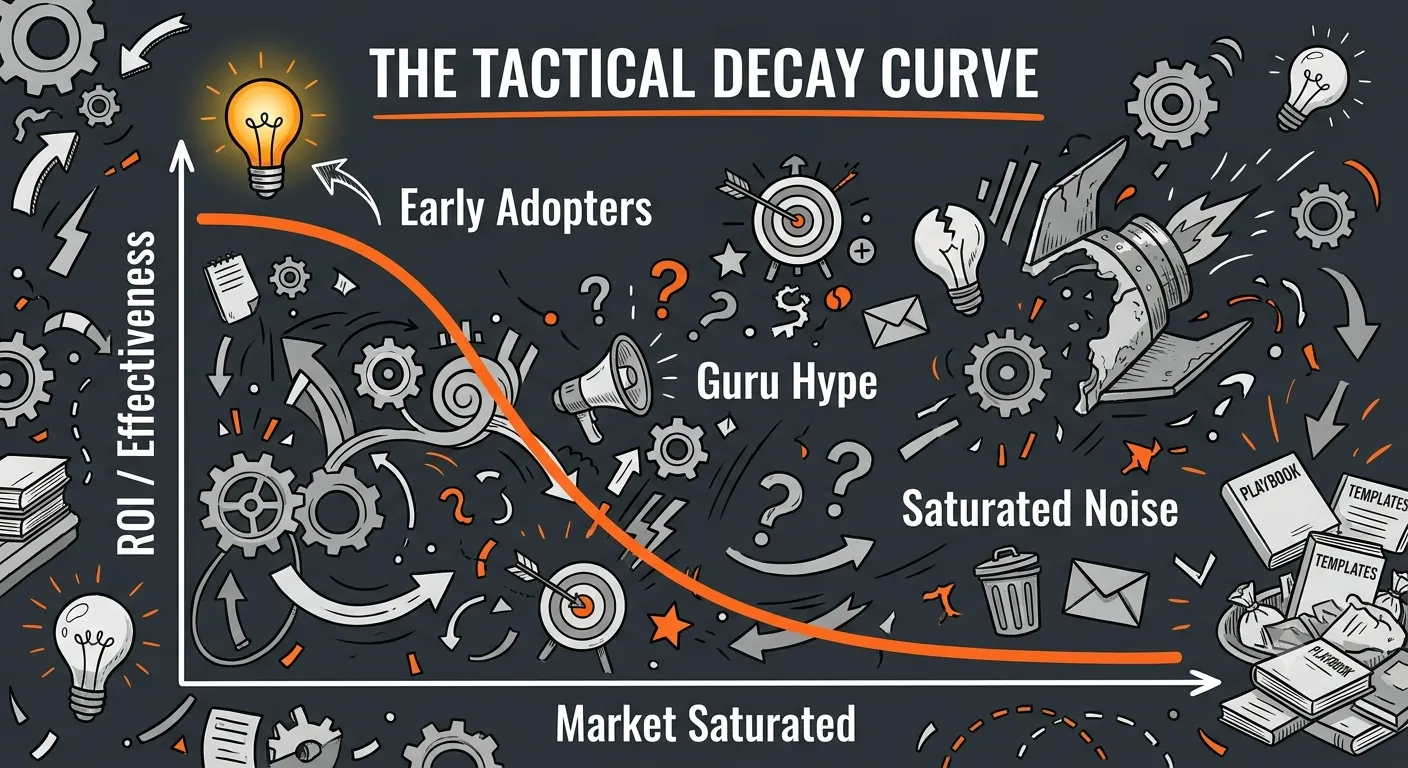
In marketing, tactics have a half-life.
When a new channel or approach opens up, early adopters win big because the audience hasn’t built up immunity yet. But as soon as the playbook goes mainstream, the market becomes saturated. The audience develops “fatigue.” And the ROI of that once-brilliant tactic drops to near-zero.
We see this constantly with businesses that come to us. They’ve bought the “guaranteed” outbound playbooks, hired agencies to “post consistently,” or built elaborate marketing funnels because a LinkedIn guru said it was the only way to scale.
They spend ₹1L, ₹2L, or more on execution. They follow the templates exactly. And they get zero leads.
The problem isn’t their effort. It is the decay rate of generic advice.
The Saturation Trap of the “Silver Bullet”
Before you copy another competitor’s marketing campaign, you need to understand why generic advice spreads so quickly.
Generic marketing advice is highly seductive. It’s easy to consume. It doesn’t require you to think deeply about your business. It promises a silver bullet—a simple, step-by-step recipe that guarantees success.
“Post five times a day on LinkedIn.”
“Build a content engine.”
“Run cold email sequences.”
These sound like actionable tactics. But they are the business equivalent of fortune cookie wisdom. They sound profound until you try to use them to pay your rent.
Here is what the people selling those playbooks never tell you: the effectiveness of any marketing tactic is inversely proportional to how many people are doing it.
When cold email software made it possible to send 10,000 automated emails a day for $50, the channel died. Not because email doesn’t work, but because the average decision-maker’s inbox became an unreadable swamp of identical, automated “quick question” templates. Audiences developed advice fatigue. They learned to filter out the noise.
Context Is the Only Real Strategy
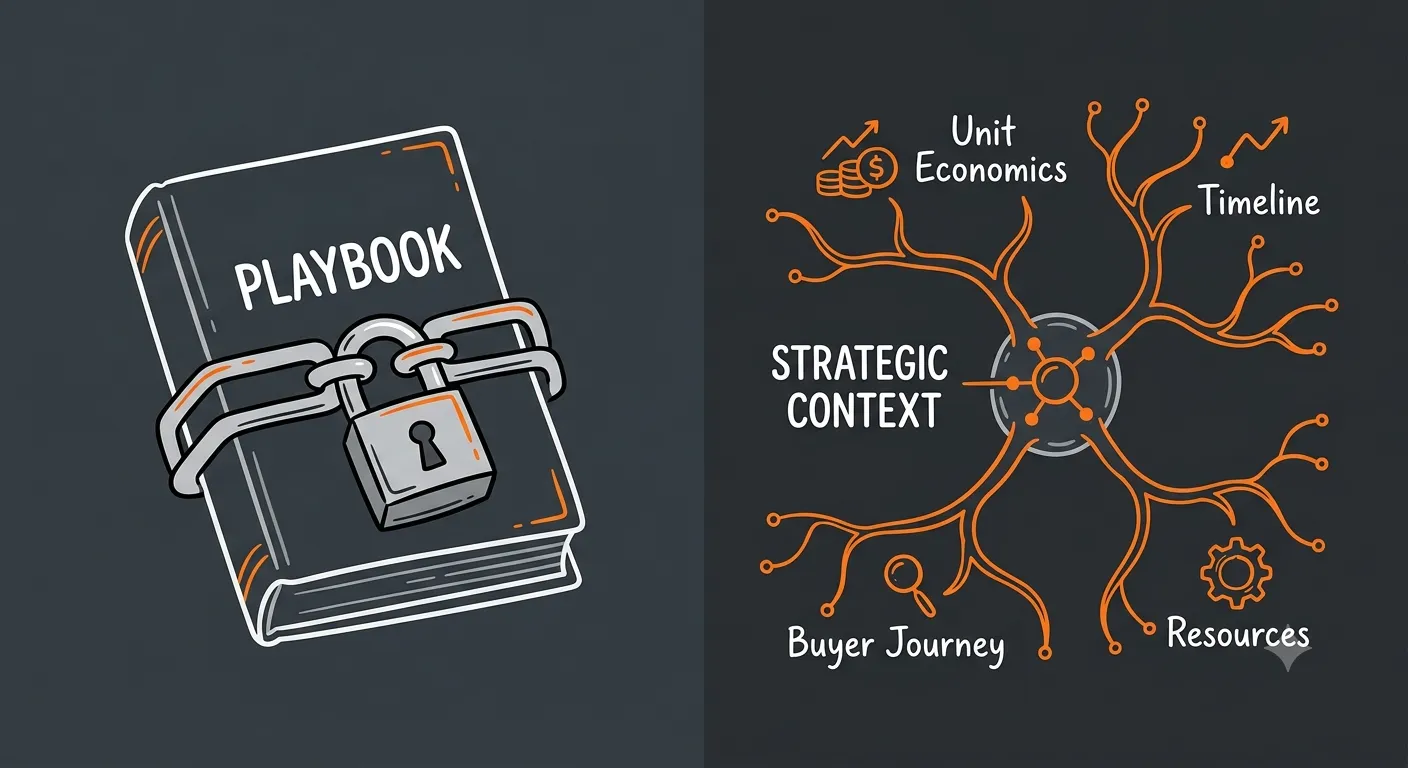
The fundamental flaw of the “advice industrial complex” is that it strips away context.
But in marketing, context is everything.
When a venture-backed SaaS founder tells you to build a massive “content moat” and run expensive brand-awareness ads, they are operating in a specific context. They have high customer lifetime value, low product delivery costs, and investors willing to wait 12 months for ROI.
If you are a local service provider, a specialized clinic, or a boutique consultancy with tight margins and a payroll to meet next month, that exact same advice is actively dangerous. You don’t need a content moat. You need direct, high-intent traffic, a clear offer, and an optimized conversion path.
The Strategic Audit
Before choosing a tactic, you must ask the questions most playbooks ignore:
- Who is your specific buyer? Not “small businesses,” but actual people with specific, budget-holding frustrations.
- What is your unit economics? How much can you actually afford to spend to acquire a single customer?
- What is your cash runway? Do you need revenue this month, or can you afford to build brand equity for the next year?
- What resources do you actually have? Time, money, technical skills, or focused attention.
Once you answer these questions, your strategy becomes clear. Not easy, but clear.
The tactic is never the strategy. The context is the strategy.
The “Post Consistently” Distraction
The most common trap business owners fall into is the volume distraction.
When marketing isn’t generating leads, the default response is almost always: “We need to post more content. We need to be more consistent.”
This is like trying to fix a leaky bucket by pouring water in faster.
In 2026, the internet is flooded with generic, safe, AI-flavored copy. Because anyone can generate a polished, 1,000-word blog post in 10 seconds, the value of “safe” content has plummeted to zero. Audiences are highly sensitive to bland, automated corporate speak. They can smell generic advice from a mile away.
If a competitor can copy your social media post, paste it onto their website, and change the logo without anyone noticing a difference, you haven’t built brand equity. You’ve just written filler.
“Volume does not fix an unclear message. It only makes your lack of clarity louder.”
Differentiation does not come from doing what everyone else is doing, only faster. It comes from having a distinct point of view, sharing real-world experiences, and speaking in your customer’s actual language.
A Real Story: The ₹1.5L Playbook That Failed
A B2B consulting client came to us after spending ₹1.5L on a “proven” outbound sales campaign. They had bought the templates, set up the domain redirects, and automated their outreach exactly as the course instructed.
After two months, they had sent over 4,000 emails. The result? Zero qualified leads.
The problem wasn’t the email delivery or the targeting parameters. The problem was the message.
The email template they used was a beautifully formatted, highly polished pitch explaining their 15 years of industry experience and their “custom-tailored, client-first approach.”
It was the exact same template that every other consultant in their niche was using. The prospects they targeted were receiving five identical emails a day. They didn’t even read them; they archived them instantly.
We threw away the playbook. We stopped the automated blasts. Instead, we wrote a highly specific, one-paragraph email addressing a single, painful regulatory change that their target CFOs were currently struggling with. We sent 50 highly targeted, personalized emails instead of 4,000.
The response rate went from 0.2% to 18%.
That is the difference between a generic playbook and contextual clarity.
The 3-30-3 Rule of Modern Attention
When you communicate with your audience online—whether through an ad, a landing page, or a social post—you are fighting for survival in a highly distracted environment.
You must design your messaging around the 3-30-3 Rule:
- 3 Seconds to grab their attention with a highly specific hook.
- 30 Seconds to engage them and show that you understand their exact pain point.
- 3 Minutes to deliver real value and present a clear, low-friction next step.
If your message is generic, you lose them in the first 3 seconds. If your landing page has five different call-to-actions, they leave within 30 seconds.
Instead Of Copying This | Try This Instead |
|---|---|
“Post consistently” templates | 1 exceptional, opinion-led post per week |
Safe, generic educational advice | Specific case studies with real, unvarnished data |
Automated outreach blasts | Low-volume, hyper-targeted personal messages |
Complex, multi-stage funnel | One clear value proposition with a single CTA |
Where Do You Go From Here?
Stop looking for silver bullets in other people’s marketing playbooks. What worked for a SaaS company in Silicon Valley last year will not work for your local business or professional practice today.
Instead, run an audit of your business’s fundamentals:
- What is the single, most acute problem you solve for your customers? (Say it in one simple sentence, without jargon).
- Where do your most profitable customers actually come from right now? (Double down on what is already working before chasing new platforms).
- What makes your brand genuinely different from the next result on Google? (Evidence, case studies, and a unique point of view, not adjectives like “innovative” or “client-focused”).
- Is the next step for your prospects clear, simple, and low-friction?
- Before you spend more budget on ads, SEO, or content creators, make sure your message is ruthlessly clear. No amount of traffic will fix unclear thinking.
Think your marketing message might be losing its impact?
We do free, human-reviewed marketing audits. A real person from our team will look at your website, your ads, and your messaging, and tell you exactly what is killing your leads.

Comments