The uncomfortable truth is that most people have built a perfectly functional workflow around the least powerful way to use an AI model. Here's how to actually fix that.
There's a quiet ritual that plays out millions of times a day. Someone opens ChatGPT, types a question, skims the output, pastes it somewhere, and moves on. It works well enough until it doesn't. The ideas feel borrowed. The tone misses. The strategy is technically correct but somehow hollow.
At that point, most people blame the tool. But the tool isn't the problem. The workflow is.
ChatGPT is not a search engine with better grammar
The single biggest misunderstanding about language models is treating them like a smarter Google. You ask, it answers, you leave. But ChatGPT is a reasoning model that responds to context depth. It mirrors the quality of thinking you bring to it.
Think of it this way: If you hired a consultant and your entire brief was "give me ten marketing ideas," you'd get ten generic ideas. If you spent 45 minutes explaining your audience, your competitors, what's working, what failed last quarter, and why your current positioning feels off you'd get something different entirely. ChatGPT works the same way.
The conversation-first method (most people skip this entirely)
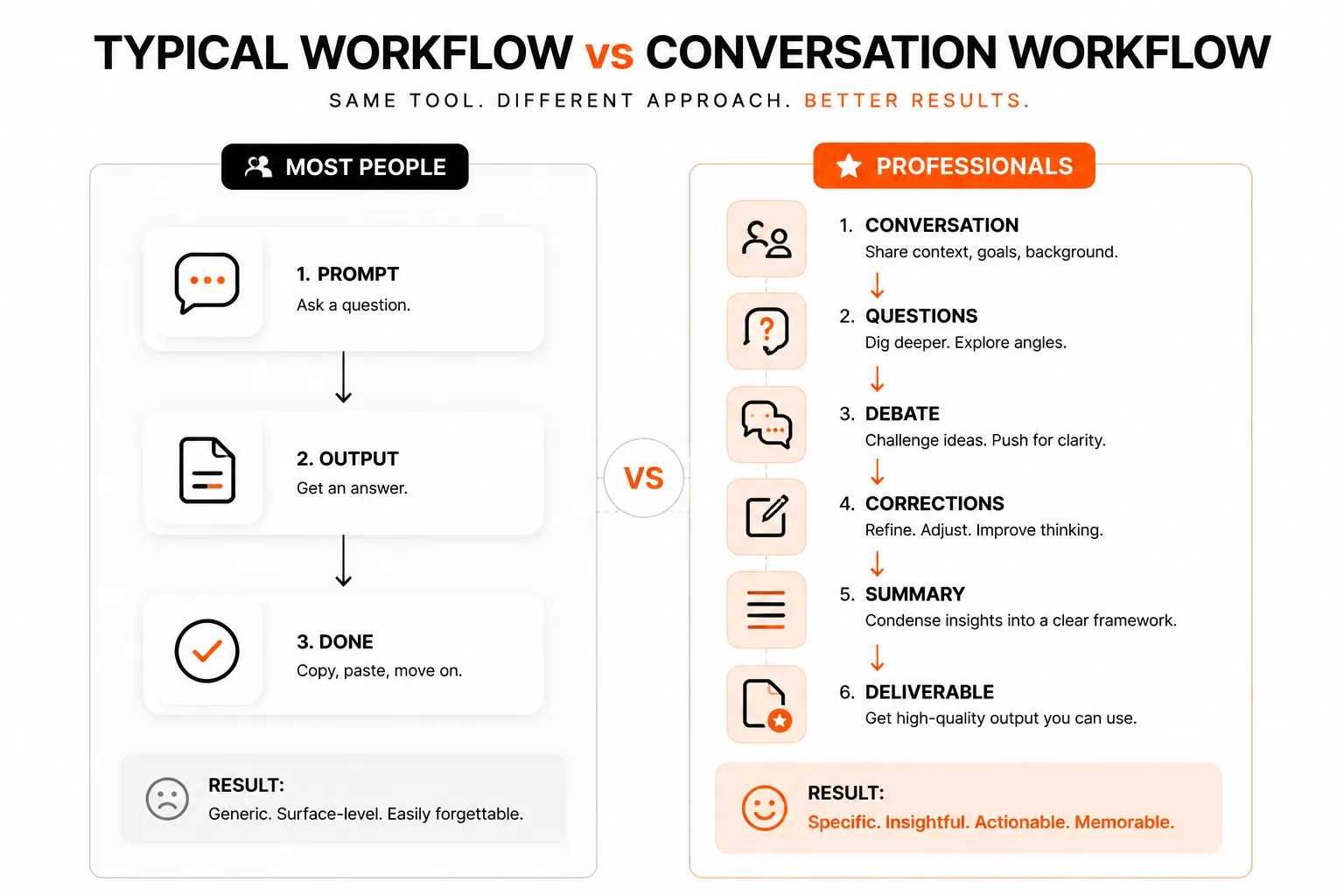
Before you ask for a deliverable - a post, a brief, a strategy - spend time just talking. Not generating. Not prompting for output. Talking.
Here's what that looks like in practice. Say you run a digital marketing agency and want fresh content angles. Most people start here:
Typical Approach
User :Give me 10 Instagram content ideas for a digital marketing agency.
ChatGPT :
1. Share a client success story.
2. Post a marketing tip of the week.
3. Behind-the-scenes of your team...
Result: Content anyone could have thought of. Content that already exists everywhere.
Conversation-First Approach
User :
We are a team of x people specialized in y things.
- Who generally get attracted towards agencies like us.
- Why do most agency social media pages look identical to each other?
- What to do to stand out from other social media agencies?
- Why are individual founders and freelancers outperforming branded agency accounts right now?
Now ChatGPT isn't generating ideas. It's building a contextual model of your world before you've asked for anything.
After 15–20 minutes of this, then ask for content ideas. What comes out will be unrecognizable compared to the first approach.
Productive friction: why you should argue with an AI
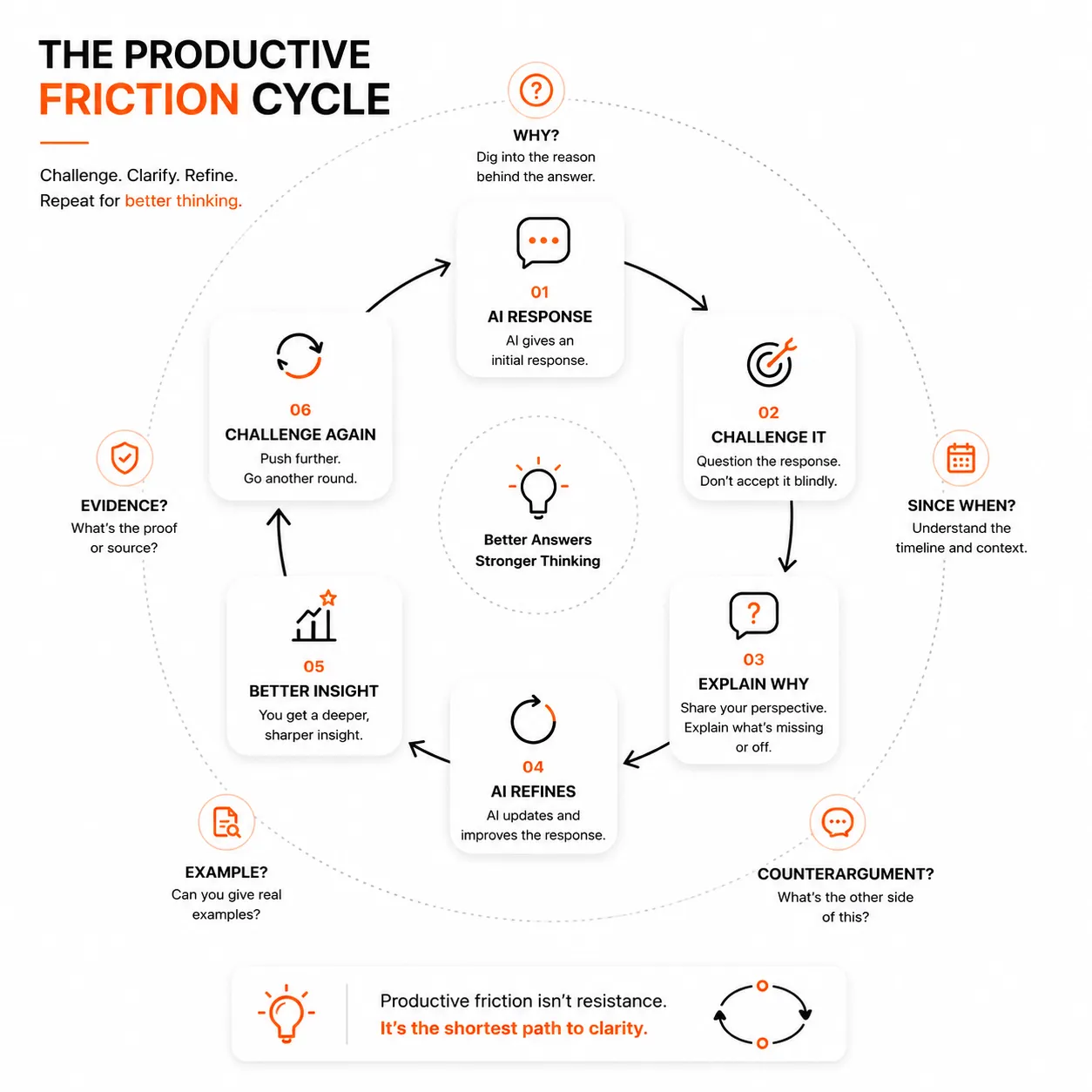
This is the part that genuinely surprises people. The best outputs don't come from smooth agreement. They come from pushback.
When ChatGPT says something that feels too safe or too conventional, don't accept it and challenge it. This forces the model to go deeper instead of wider.
Real Example : Pushing For Nuance
ChatGPT :
"Educational content consistently performs well on LinkedIn for B2B brands."User :
That was true in 2021. Generic educational content is saturated now. Opinion-led content with a contrarian take is what's actually getting engagement. Why did that shift happen?
ChatGPT :
You're right. The shift happened because LinkedIn's feed became overrun with polished, safe "tips" content. Audiences developed what's essentially advice fatigue. Contrarian or experience-based perspectives stand out because they introduce friction they make people stop scrolling to either agree or disagree...
That second response is actually useful. The first one wasn't. The difference was one pushback.
Good follow-up questions to keep in your toolkit: Since when? Which specific examples? What caused that? What's the counterargument? Who's doing this differently and why?
Treat ChatGPT like a junior strategist, not an oracle
There's a failure mode on both ends of the trust spectrum. Some people take every AI output at face value. Others dismiss it entirely and use it only for rote tasks. Neither is the right position.
The better mental model: ChatGPT is a brilliant, well-read junior strategist who works incredibly fast but lacks your lived experience. Your job is to supply the context, challenge the reasoning, and correct the blind spots not to either rubber-stamp the output or ignore it.
Concretely, this means when ChatGPT gives you a strategy that feels off, say so and explain why. When it cites a trend, ask it to name specific creators or campaigns. When it's being vague, ask it to be specific. The model gets sharper as the conversation gets more demanding.
The workflow that actually produces good output
Most people run this in the wrong order. They research first, then try to form a strategy around what they found. The problem is that without a clear point of view, research becomes noise and you end up collecting data with no lens to interpret it through.
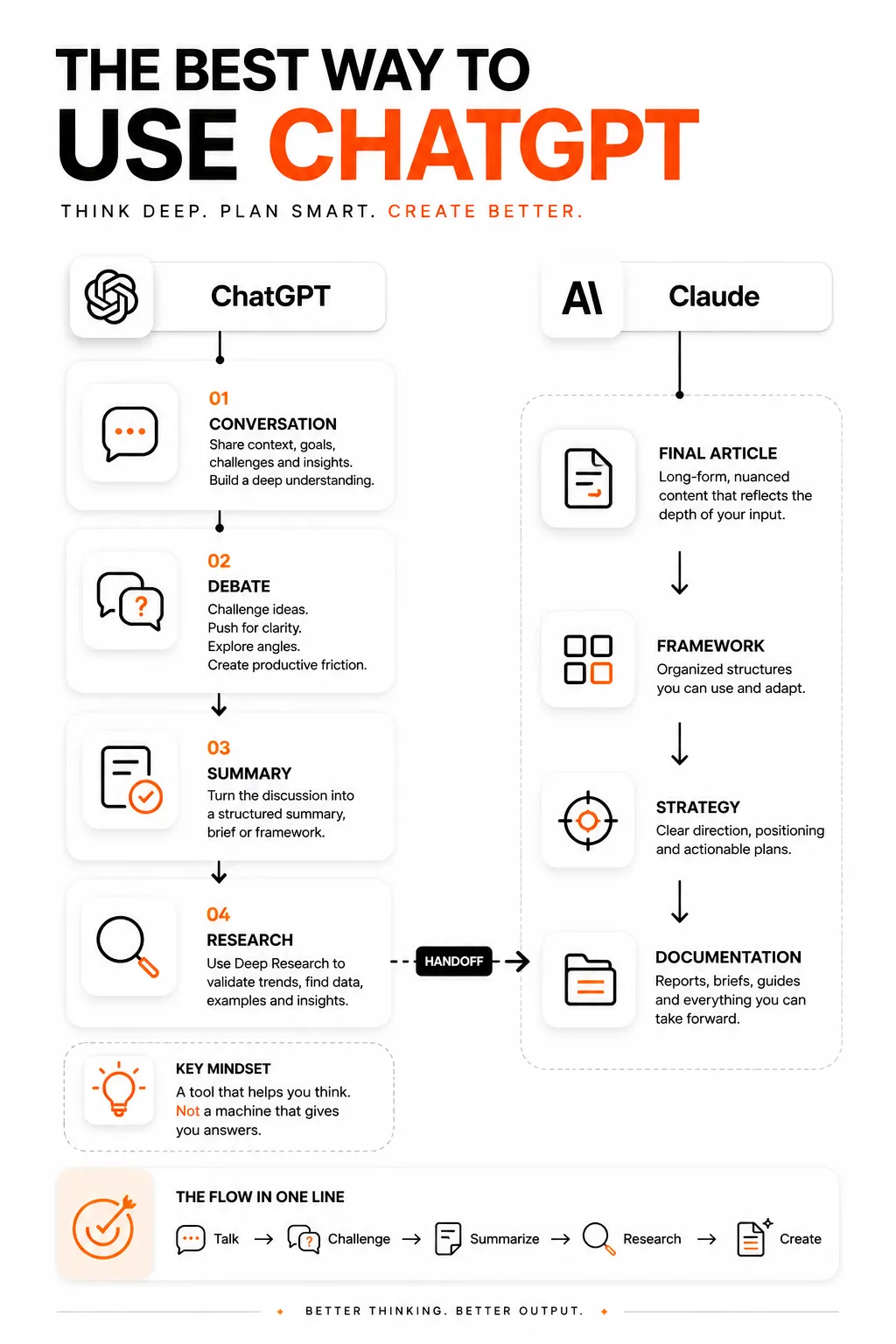
Here's the sequence that works:
STEP 01 - Conversation
Explore industry shifts, audience frustrations, your own observations. No deliverables yet just build shared context.STEP 02 - Debate & Friction
Challenge what ChatGPT says. Push back on conventional takes. Force specificity. Refine the direction through disagreement.STEP 03 - Structured Summary
Ask it to compress the entire conversation into a strategic brief, positioning doc, or content framework. Now the output is custom.STEP 04 - Targeted Research
Only now use Deep Research mode to validate the trends, patterns, and market gaps that your strategy has already identified.The summary step is where most people see the biggest jump in quality. Instead of "write me a content strategy," you're saying "here's 20 minutes of strategic discussion - compress it into a framework."
That's a completely different instruction, and the output reflects it.
What to actually ask: "Summarize everything we've discussed into a brand positioning document I can give to a copywriter." Or: "Turn this conversation into a content personality system with voice guidelines and topic pillars." The specificity of the final ask matters as much as the quality of the conversation that preceded it.
Now ditch ChatGPT. Yes, seriously.
You've done the hard part. You have a conversation full of sharp thinking, challenged assumptions, and strategic clarity. You have a research doc. You know what you want to say and why it matters.
This is precisely the moment most people make the mistake of staying in ChatGPT and asking it to "write the final thing." Don't.
Here's what happens when you dump a long, complex brief into ChatGPT and ask for final output: it summarises. It flattens. It picks the most prominent ideas and presents them cleanly, leaving the nuance you spent 20 minutes developing somewhere on the cutting room floor. The output is technically on-brief, but it has lost the texture of the conversation that produced it.
Claude handles this differently. Give it a dense, multi-layered document, a conversation export, a research summary, a positioning brief and it actually reads all of it. The final output reflects the complexity of the input, not just the headline version of it.
What to hand Claude (and in what order)
Think of Claude as the final-mile specialist. Everything before this point was about generating the right raw material. Now you're asking someone to actually build something from it.
What you bring from ChatGPT | What Claude produces |
|---|---|
Your raw material
| Structured final output
|
The order matters. Don't summarise before handing it over give Claude the full mess and let it do the compression. It's specifically good at finding the signal inside large amounts of context. Summarising it yourself first is doing Claude's job for it, and doing it worse.
Short Summary
If your AI outputs feel generic, it's almost never the model's fault. It's the interaction pattern. Treating ChatGPT like a vending machine input prompt, receive output, judge and discard will always produce mediocre results, regardless of how sophisticated the underlying model is.The alternative isn't complicated. Spend time in conversation before asking for deliverables. Challenge the model's reasoning when it feels too safe. Use the structured summary step before you move to research. And recognize which tool in your stack does which job best.
The people getting genuinely impressive results from AI aren't finding better prompts. They're building better thinking habits and using AI as the thing that makes those habits visible.
Comments